
There is something deeply satisfying about a collection where each piece is its own complete world, where every composition opens and develops and closes with its own internal logic, like chapters in a book of short stories. Rather than an album that flows as a single continuous statement, there is a particular richness in a work where each track governs itself by its own rules, its own instrumentation and tempo and sense of direction. Otto Orany has created exactly such a collection, and 10 Blue-Penciled Stories, the ten-track album released June 19, 2026 via Protomaterial Records, presents ten compositions each governed by its own internal rules. Written for a hybrid ensemble of woodwinds and harpsichord and keyboards and bass and drums, the album offers ten distinct worlds, each a self-contained story that opens and develops and closes like a chapter.
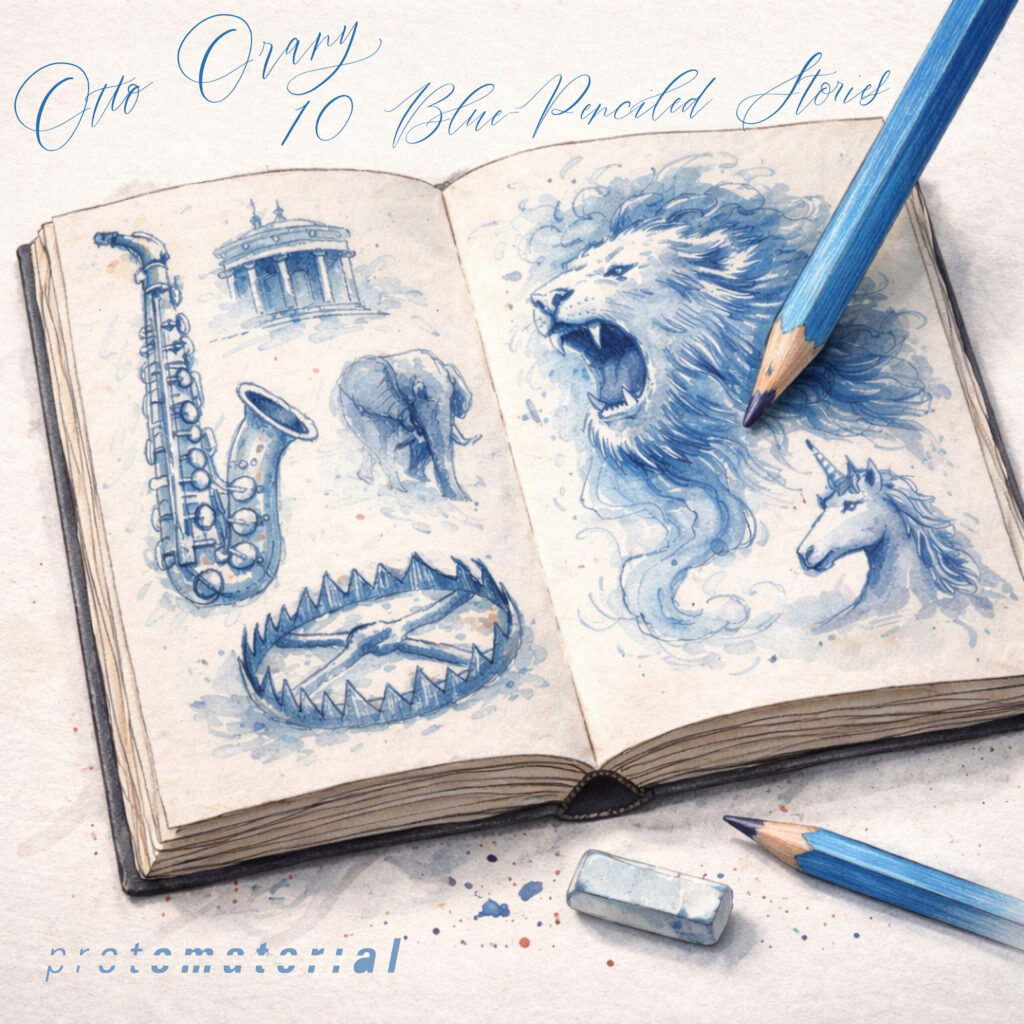
The concept behind 10 Blue-Penciled Stories gives the album its distinctive structure. The title is not a conceit, Orany having written ten pieces each governed by its own internal rules, its own instrumentation and tempo logic and sense of where it is going. Nothing on the album spills into the next track, these being compositions that open and develop and close, one after another, like chapters. This concept gives the album its distinctive character, each piece being a complete, self-contained world rather than part of a continuous flow, the album functioning as a collection of ten distinct stories. This structural approach distinguishes the album, 10 Blue-Penciled Stories being not one long argument but ten separate compositions, each with its own logic and its own world. This chapter-like structure gives the album its richness, each track offering a distinct experience, the collection rewarding listening as a series of complete, individual works.
The distinctive register of the track titles gives the album its character. The track titles give a sense of the album’s register, with names like Tiptoe Elephant and Running Unicorn and Temple of Friendship. There is humor here, and something almost childlike in the best sense, a willingness to name things directly without irony and then take the name seriously as a compositional premise. This approach to naming is genuinely charming, the titles being both playful and serious, the direct, imaginative names becoming compositional premises that the music takes seriously. This register distinguishes the album, the willingness to name things directly and imaginatively reflecting a childlike creativity and openness, the titles giving the compositions their distinctive character. This playful yet serious approach gives the album its charm, the imaginative titles reflecting Orany’s willingness to explore whimsy and directness without irony.
The album opens with Berk Lee’s Aquarium, a title whose playful wordplay on the famous music school suggests both aquatic imagery and musical education. This opening establishes the album’s imaginative, playful register, the aquarium suggesting a watery world of floating movement and color. Tiptoe Elephant follows, a delightful image of contradiction, the massive elephant moving delicately on tiptoe, the title suggesting a composition of careful, perhaps humorous movement. This track embodies the album’s playful spirit, the tiptoeing elephant being a charming image that becomes a compositional premise. Gloria in excelsis Nio brings a play on the traditional Latin phrase of praise, the substitution creating a title that is both reverent and playful, the sacred phrase given a personal twist.
Lions Eat First, the fourth track and first single, names something the album keeps circling: appetite and hierarchy and what comes first. This title captures a theme that resonates through the album, the lions eating first embodying the natural order of appetite and precedence, the composition presumably exploring this idea of hierarchy and priority. This track brings a note of primal power to the album, the lions eating first embodying the natural hierarchies and appetites that govern the world. Melody for Melissa brings a personal, tender quality, the dedication suggesting a piece written for someone specific, the melody carrying genuine warmth and affection. This track brings intimacy to the album, the melody for Melissa being a personal, heartfelt composition amid the more playful and conceptual pieces.
Rainbow Rock brings a colorful, energetic image, the rainbow suggesting beauty and spectrum while the rock suggests both solidity and musical energy. This track brings color and energy to the album, the rainbow rock embodying a bright, vibrant composition. Running Unicorn brings another imaginative, whimsical image, the mythical unicorn in motion suggesting fantasy and grace and forward movement. This track embodies the album’s imaginative spirit, the running unicorn being a magical, dynamic image that becomes a compositional premise. Temple of Friendship brings a warm, meaningful image, the temple suggesting reverence and permanence while friendship suggests human connection, the combination creating a sense of sacred human bonds. This track brings warmth and depth to the album, the temple of friendship celebrating the sacred nature of human connection.
Theme for Team brings a sense of collective purpose, the theme for a team suggesting unity and shared endeavor, the composition perhaps embodying the spirit of working together. This track brings a sense of collective spirit to the album, the theme for team celebrating unity and shared purpose. The album closes with Trapped in Rap, the second single, a title that suggests entrapment in form or perhaps a wry affection for it. Closing the album, Trapped in Rap brings a note of playful self-awareness, the entrapment in form perhaps reflecting on the constraints and pleasures of musical structure, the wry title providing a fitting, self-aware conclusion. This closing track gives the album a playful, thoughtful ending, the trapped in rap reflecting on form and structure with wry affection.
The remarkable hybrid ensemble gives 10 Blue-Penciled Stories its distinctive sound. The album is written for a hybrid ensemble that puts saxophone and oboe and English horn and bassoon and contraforte and clarinet alongside a harpsichord and a rhythm section, a combination that does not belong to any single tradition and does not try to. This woodwind core draws from both the jazz and the chamber tradition, while the harpsichord pulls the harmonic language in an older direction, and bass and drums keep the whole thing from floating. This remarkable ensemble gives the album its unique sound, the combination of woodwinds and harpsichord and rhythm section creating something that belongs to no single tradition. This hybrid instrumentation allows the music to move from something close to a chamber miniature to something close to a groove without either register feeling forced, the ensemble making the album’s shifts between registers possible.
The genre-crossing approach that defines the album reflects Orany’s artistry. A Czech composer and keyboardist who has spent the better part of a decade working at the intersection of contemporary classical music and jazz and electronics, Orany does not treat these as styles to blend. Instead, each piece on the album makes specific choices about which language is doing the work at any given moment, and those choices shift. This approach is genuinely sophisticated, Orany not simply blending genres but making deliberate choices about which musical language governs each moment, the shifts between languages giving the album its variety and its depth. This is what makes the album ten stories rather than one long argument, each piece making its own choices about which tradition is at work. This genre-crossing approach reflects Orany’s artistry, the album demonstrating a sophisticated command of multiple musical languages.
The way the ensemble enables the album’s shifts gives it its flexibility. In practice, the hybrid ensemble means the music can move from something close to a chamber miniature to something close to a groove without either register feeling forced. This flexibility is central to the album’s success, the ensemble allowing Orany to move between the chamber and jazz traditions, between the delicate and the driving, without strain. This ability to shift registers gives the album its variety, each piece able to occupy its own musical space, the ensemble providing the range that the ten distinct stories require. This flexibility reflects the genius of the ensemble’s design, the combination of woodwinds and harpsichord and rhythm section giving Orany the palette to create ten genuinely distinct worlds.
The way Orany moves between registers gives the album its sophistication. Orany moves between registers without announcing the transitions, Gloria in excelsis Nio sitting next to Lions Eat First, the sacred beside the primal, the playful beside the profound. This movement between registers is genuinely sophisticated, Orany shifting between the humorous and the serious, the whimsical and the profound, without heavy-handed announcement, the transitions feeling natural rather than forced. This ability to move between registers gives the album its richness, the collection encompassing a wide emotional and stylistic range, each piece occupying its own register while the album as a whole moves fluidly between them. This sophisticated movement between registers distinguishes the album, Orany demonstrating a mastery of tone and mood that gives the collection its depth and variety.
10 Blue-Penciled Stories is the sound of ten distinct worlds, an album of ten compositions each governed by its own internal rules, written for a remarkable hybrid ensemble. Otto Orany has created a collection that functions like a book of short stories, each piece opening and developing and closing with its own logic, the woodwinds and harpsichord and rhythm section enabling movement between chamber miniature and groove.
From the tiptoeing elephant to the running unicorn, from the sacred to the primal, Otto Orany has written ten stories each its own complete world. 10 Blue-Penciled Stories is a work of genuine imagination and sophistication, and its willingness to name things directly and then take those names seriously as compositional premises confirms Orany as a composer who moves between musical languages with rare fluency, crafting ten distinct chapters that never spill into one another.


