
There is a specific ambition required to build an entire project around the idea that gravity and desire operate on the same underlying logic, and Hyperflower commits to that premise with genuine rigor across seven interconnected tracks. This is not a duo borrowing scientific language for aesthetic decoration. Lorenzo Setti and Irene Cavazzoni Pederzini have constructed something closer to a working thesis, using mathematical structure, Platonic philosophy, and astronomical imagery as actual scaffolding for songs about attraction, distance, and the particular ache of never quite fully reaching another person. The result asks real patience from listeners, but it rewards that patience with a coherence rare in projects this conceptually loaded.
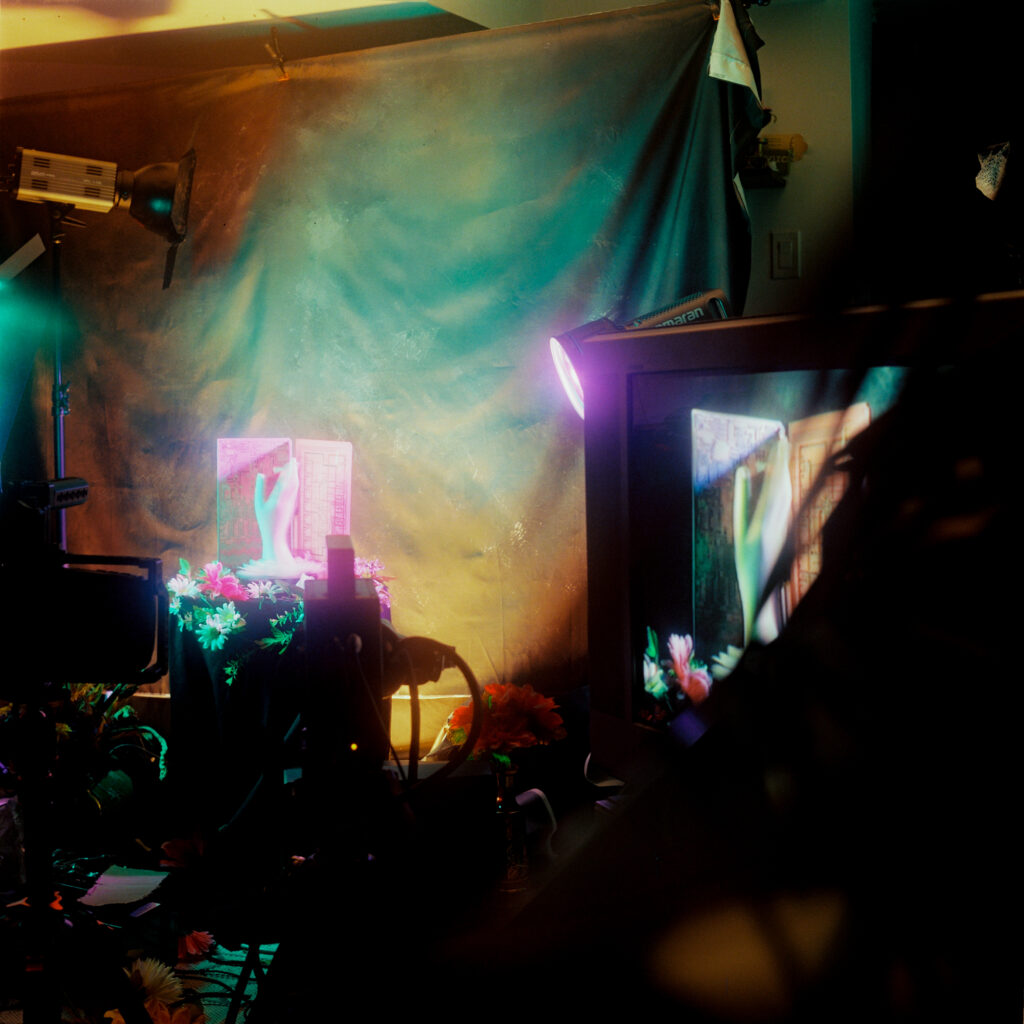
Fold opens the EP with a title suggesting compression, folding space or folding emotion into something denser than its original form, and that image sets the tone for how the record approaches intimacy throughout. Rather than presenting vulnerability as something that simply gets exposed or revealed, Hyperflower treats emotional closeness as something structurally complex, requiring actual pressure and transformation to occur. The track’s ethereal vocal work sits inside carefully sculpted electronic texture, establishing early the record’s central technique of letting abstraction and feeling constantly inform each other rather than existing as separate layers stacked on top of one another.
Tight follows with an even more directly physical title, evoking closeness bordering on constraint, and the sequencing here feels intentional, moving from the conceptual folding of the opener into something bodily and immediate. There is a tension embedded in the word itself, since tightness can signal both comfort and restriction depending entirely on context, and that ambiguity fits comfortably within an EP explicitly interested in how attraction and distance operate as two sides of the same underlying force rather than opposites. The track’s fractured rhythmic approach reinforces that duality, refusing to settle into anything as simple as pure comfort or pure tension.
Hold continues this progression toward physical, relational vocabulary, and by this third track a clear pattern has emerged in how Hyperflower sequences emotional intensity, cycling between minimalist restraint and moments of fuller saturation rather than building toward one single climactic release. That structural choice mirrors the project’s stated interest in cyclical composition and evolving loops, treating repetition not as a limitation but as an expressive tool capable of carrying real emotional weight through subtle variation rather than dramatic contrast. Distorted vocal treatments woven throughout suggest something being processed or transformed in real time, consistent with an EP more interested in showing change happening than describing it after the fact.
The title track Hyperflower arrives at the record’s center, and its placement here functions as a genuine thesis statement for everything surrounding it. Where the earlier tracks establish physical and relational vocabulary, this piece seems positioned to draw those threads together into something closer to the project’s core philosophical argument, the idea that beauty and connection exist as ideal forms, forever glimpsed but never fully grasped in complete totality. That framing borrows directly from Platonic thought, treating love as something approached asymptotically rather than achieved outright, and hearing that concept translated into actual sound rather than left as pure lyrical assertion is where the project’s ambition becomes most clearly justified.
Gravity picks up the record’s astronomical imagery most explicitly, using the physical force that governs planetary motion as a direct metaphor for desire’s pull between two people. This is smart conceptual territory for electronic composition specifically, since gravity as a force operates continuously and invisibly, exactly the kind of ongoing, unseen influence that ambient and experimental electronic texture can represent more convincingly than more conventional song structures might manage. The track likely leans into the EP’s interplay between minimalism and saturation most dramatically here, given how naturally gravitational pull suggests both quiet constant presence and moments of sudden, overwhelming intensity depending on proximity.
Proximity follows as an almost inevitable companion to Gravity, narrowing the astronomical scale down to something more intimate and immediate, the specific charge of closeness itself rather than the abstract force drawing two bodies together. Placing these two tracks adjacent to each other in the sequencing reinforces the EP’s overall method, taking a single conceptual idea and examining it from multiple angles across successive tracks rather than exhausting each theme within a single song. That approach gives the project genuine cumulative weight, since ideas introduced early continue developing and recontextualizing themselves as the tracklist progresses rather than simply being stated once and abandoned.
Hyperlapse closes the EP with a title borrowing from time lapse photography terminology, suggesting compressed time, accelerated change, watching transformation unfold at a pace faster than lived experience normally allows. As a closing statement, that concept fits naturally with an EP so concerned with deterioration and transformation as legitimate expressive tools throughout its runtime. Ending on an image of accelerated time passing gives the project a sense of zooming outward at its conclusion, pulling back from the intimate, granular examination of connection found in the earlier tracks toward something more expansive and temporally vast, mirroring the astronomical scale introduced earlier in Gravity and bringing the whole project full circle.
What ultimately distinguishes Hyperflower from other projects working in similarly experimental electronic and art pop territory is how genuinely integrated its conceptual framework feels with its actual sonic choices, rather than existing as separate intellectual justification layered on top of otherwise conventional songwriting. Setti’s programming and compositional work alongside Cavazzoni Pederzini’s vocal and lyrical contributions creates something that sounds collaboratively considered at every level, mixed by Davide Cristiani and mastered by Andrea De Bernardi with enough clarity that the project’s more abstract ambitions never collapse into pure murk or inaccessibility. This remains, throughout its seven tracks, genuinely listenable pop adjacent material even while pursuing ideas considerably more rigorous than most projects working in adjacent genre space typically attempt.
By the time Hyperlapse fades into whatever comes after it, the EP has made a genuinely persuasive case for treating scientific and philosophical concept not as external decoration applied to music, but as something capable of generating real emotional insight when taken seriously enough. Prime numbers, gravitational pull, Platonic ideal forms, all become vocabulary for describing something as ordinary and universal as wanting to be close to another person and never quite managing to close that final distance completely. Hyperflower suggests that gap is not a flaw in human connection to be solved, but the actual mechanism through which desire continues generating itself indefinitely, always reaching, never quite arriving, and somehow more beautiful precisely because of that permanent incompletion.


