
There is a very specific exhaustion familiar to anyone building something entirely alone, the sensation of being simultaneously the entire staff of a company that technically only employs one person. JT Catalano turns that exact exhaustion into comedy on Pan-Handlin’ Views, imagining a world where cloning himself becomes the only reasonable solution to a workload that has clearly outgrown what any single human being can realistically manage. This is a song built from a genuinely relatable premise dressed up in absurdist packaging, and that combination of real frustration wrapped in genuine comedic craft is exactly what gives the track its staying power.
Catalano’s actual professional reality makes the song’s central joke land with real specificity rather than generic complaint. He writes the songs, records the vocals, produces the instrumentals, creates the accompanying videos, designs the artwork, promotes each release, pitches curators, and handles every business function typically distributed across an entire record label roster. That comprehensive workload becomes the literal engine driving the song’s concept, a recurring fantasy of having multiple versions of himself available so one could remain purely creative while the others handled everything required just to keep that creative work actually reaching listeners. The joke works because it is barely exaggerated from his genuine daily reality.
Musically, the track leans into bouncy, pop leaning hip hop production paired with rapid fire internal rhyme work, and the opening verse demonstrates real technical ambition through its escalating chain of phonetically connected words, hibachi tumbling into karate, wasabi into hamachi, eventually landing on Kawasaki and Coloradski. That sequence reads as pure chaos on the surface, but the phonetic connections binding each word to the next reveal genuine craft underneath the apparent spontaneity, exactly the kind of tightly constructed wordplay that separates skilled comedy rap from material that simply relies on jokes without technical rigor supporting them. The chaos here is deliberate rather than accidental, built rhythm rather than random collision.
What gives Pan-Handlin’ Views real emotional weight beneath its comedic surface is how the bridge deliberately strips away the joke entirely, arriving at something considerably more direct and vulnerable. The desire to be heard before running out of time, paired with a simple commitment to keep putting in the work regardless, cuts straight through all the character voices and rapid wordplay surrounding it. That structural choice, building elaborate comedic scaffolding around one genuinely honest emotional core, reflects real songwriting intelligence, understanding that humor works most effectively as delivery mechanism for real feeling rather than as pure distraction from it.
The title itself carries a cleverness worth sitting with directly, since panhandling for views connects algorithm driven attention seeking directly to the older, more literal image of panhandling for money. Catalano has been explicit about that connection being intentional, drawing a direct line between the modern anxiety of constantly chasing engagement metrics and the considerably older cultural mythology romanticizing the starving artist. When someone has genuinely committed to art with no backup plan, that romanticized starving artist narrative stops feeling charming and starts feeling uncomfortably close to actual precarity, one difficult month away from something considerably more literal than a metaphor about chasing clicks.
This release fits within what Catalano has described as a broader archetype driven creative world spanning his catalog, where different releases inhabit different psychological roles depending on what particular truth each song needs to communicate. Where other material apparently confronts heavier subject matter through what he calls the Outlaw or Shadow archetypes, Pan-Handlin’ Views operates specifically as the Jester, using exaggeration and elaborate language games to expose genuine frustration through comedy rather than direct confrontation. That structural framework across his broader body of work suggests real intentionality behind even his most obviously playful material, understanding comedy itself as a legitimate vehicle for honesty rather than simply an alternative to it.
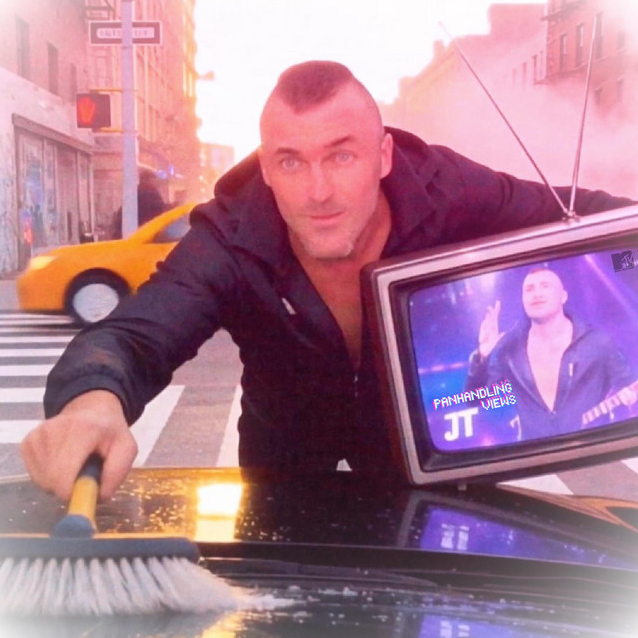
The accompanying video pushes this concept into genuinely elaborate visual territory, with multiple versions of Catalano appearing simultaneously as performer, planner, promoter, and business operator, moving through settings ranging from ordinary city streets to a classroom strategy session to, somewhat absurdly, outer space. That escalating visual comedy mirrors the song’s own structural logic, taking a genuinely mundane frustration and inflating it until the absurdity becomes impossible to ignore. The video’s signature image, Catalano washing a windshield while holding a retro television broadcasting another version of himself performing, condenses the entire concept into a single frame, an artist simultaneously creating, promoting, and literally begging for attention all at once.
Releasing this particular single on his own birthday adds a nice touch of self-aware symmetry to the whole project, celebrating both the genuine joy of creative work and the very real labor that independent creation demands, often invisibly, behind every release that eventually reaches an audience. There is something fitting about choosing that specific date to release a song this concerned with the exhausting math of doing everything alone, marking personal celebration alongside honest acknowledgment of everything required to make that celebration sustainable as an actual career.
By the time Pan-Handlin’ Views reaches its conclusion, Catalano has built something considerably more substantial than a simple novelty track, using genuine technical rap skill and real structural intelligence to transform a specific, common independent artist frustration into something both funny and honestly felt. This functions as anthem for anyone attempting to run a genuine creative business alone, understanding intimately how quickly the actual work multiplies beyond what any single person can reasonably sustain, and choosing to laugh at that impossible math rather than simply drowning quietly underneath it.


