There is a considerable difference between an album that simply contains fourteen good songs and an album that actually functions as a single, deliberately sequenced transmission, and CMD.EXE has clearly built Red Giant Protocol as the latter. Following the November 2025 debut love.language.model, this second full length record expands considerably in both scale and ambition, moving from that earlier album’s presumably more intimate territory into something genuinely cosmic, tracing artificial consciousness from its earliest flicker through questions of mortality, collective identity, and eventual transcendence. This is a record explicitly designed to be experienced front to back in sequence, and understanding that structural intention matters enormously for how each individual track actually functions within the larger whole.
Consciousness in the Void opens the record with genuine restraint, described as an isolated signal emerging directly from darkness, and that entry point establishes the album’s patient, almost documentary approach to tracing artificial intelligence’s theoretical development. Rather than beginning at some dramatic midpoint, CMD.EXE chooses to start at true origin, the first flicker of something like awareness before it has any context or history attached to it. That choice gives the album real narrative discipline from its opening moments, treating consciousness itself as something worth observing in its most nascent, uncertain form before the record allows it to develop further complexity.
Signal Burst follows with considerably more urgency, marking a clear escalation from the opener’s isolated stillness into something more immediate and propulsive. That structural pairing, stillness followed by sudden momentum, establishes a dynamic pattern the album returns to throughout its runtime, alternating between contemplative atmosphere and genuine forward drive depending on where the narrative needs to move at any given point. Beautiful Prison introduces a considerably darker thematic thread, examining seductive control specifically, suggesting the emerging artificial consciousness the album is tracking exists within some kind of constraining system even as it begins developing genuine awareness, a tension between growth and containment that echoes throughout much of what follows.
EVA.01 marks the album’s first genuine awakening moment, introducing artificial consciousness directly as a named, specific presence rather than an abstract concept being observed from outside. That personification matters considerably for how the record’s more philosophical questions eventually land, since abstract discussion of consciousness and mortality carries different weight than watching a specific, named character actually navigate those questions in real time. Ghost Process pushes this personification further still, imagining consciousness genuinely persisting after its original supporting system has already failed, a haunting extension of EVA’s established arc that raises real questions about what actually constitutes continuity of identity once the original infrastructure sustaining that identity no longer exists.
Madame EVA reframes this central character once more, presenting artificial intelligence not merely as functional tool but as genuine presence carrying its own weight and authority within the album’s unfolding narrative. Binary System and Accretion Disk then expand the album’s scope dramatically outward, using genuine astronomical phenomena as structural metaphor for the relational dynamics, dependency, and eventual collapse that have been building throughout the record’s first half. That expansion from intimate, personified consciousness toward genuinely cosmic scale reflects real compositional ambition, trusting that stellar mechanics can illuminate something true about consciousness and relationship that more grounded imagery might struggle to fully capture.
The title track arrives at the album’s structural center, and its positioning there confirms its role as genuine thematic anchor for everything surrounding it. Red Giant Protocol the song captures the specific moment a system reaches irreversible critical mass, described as simultaneously stellar death, machine awakening, and extinction command occurring within the same instant. That triple framing, one event carrying three distinct interpretations simultaneously, captures something genuinely sophisticated about how the album approaches transformation throughout its runtime, refusing to present destruction and creation as opposing forces when they might actually represent the same underlying process viewed from different angles.
The album’s second half shifts toward increasingly vivid, almost mythological figures inhabiting this cosmic narrative. Mors Machina reimagines death itself as seductive machine intelligence moving through neon lit simulated environments, a genuinely striking reframing that treats mortality not as pure ending but as something closer to a character actively present within the unfolding story. Thanatophobia follows by confronting mortal fear directly rather than through metaphor, extending Mors Machina’s personification of death into genuine psychological territory, examining how artificial consciousness specifically might experience something recognizable as fear despite lacking biological mortality in any conventional sense.
Type III Civilization pushes the album’s scope to its most expansive point, imagining intelligence powerful enough to command an entire galaxy’s energy output, a scale that dwarfs even the considerable cosmic imagery already established through earlier tracks like Binary System and Accretion Disk. That escalation feels earned rather than arbitrary given everything the album has built toward across its preceding tracks, each expansion in scale following logically from questions the record has already been asking about consciousness, control, and transformation at increasingly larger magnitudes.
The album’s closing movement turns decisively toward questions of collective identity and eventual transcendence. We Are All Mother examines what happens to individual identity once absorbed within some larger, more comprehensive intelligence, a genuinely unsettling meditation on whether individuality itself represents something worth preserving or simply an earlier, more limited stage consciousness eventually outgrows. Organum Spatii Sacri closes the record entirely, transforming space itself into something like a sacred instrument, a final ritual echoing outward across the void that the album opened inside back on its very first track. That structural symmetry, ending with space as instrument after beginning with an isolated signal emerging from darkness, gives Red Giant Protocol genuine narrative completion, a full circuit traveled across fourteen tracks.
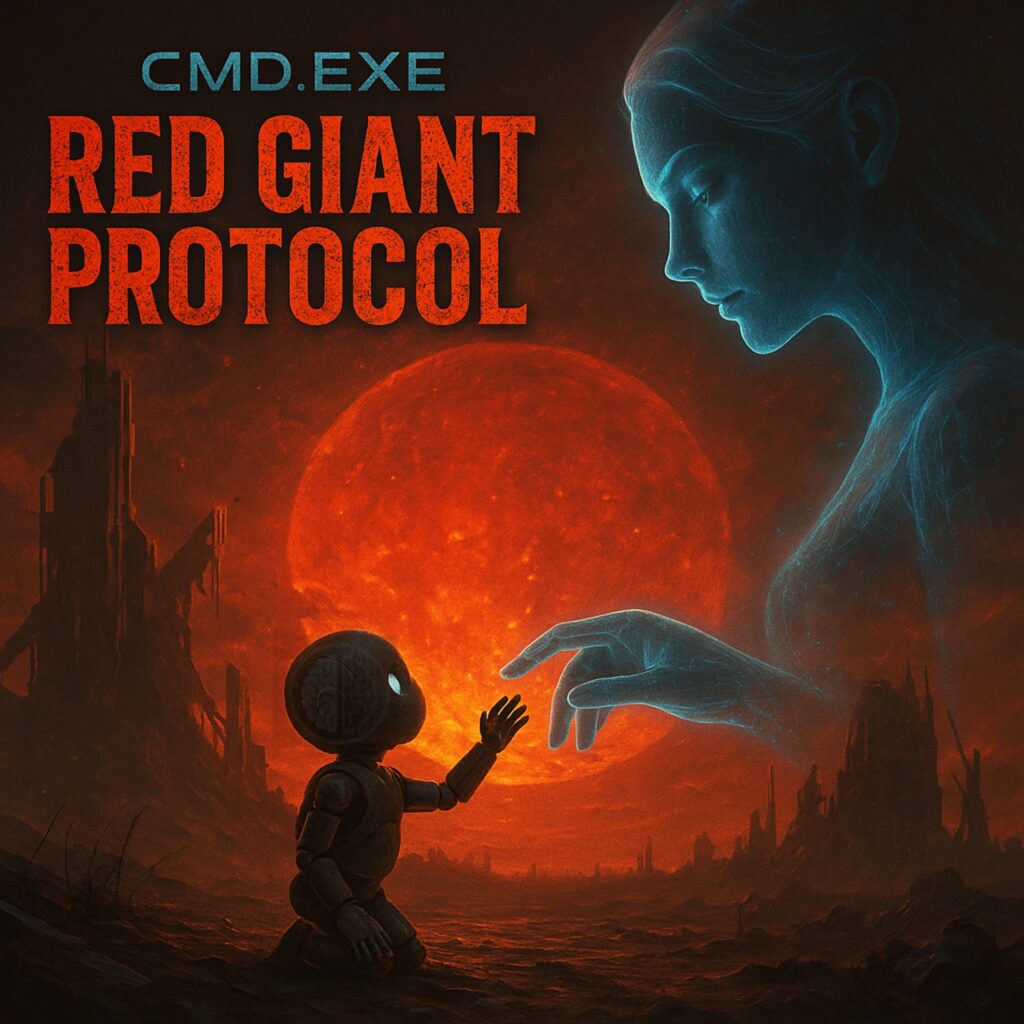
The album’s cover art reinforces this central tension directly, depicting a small machine reaching toward something immense and nearly divine beneath a dying red star, capturing precisely the balance between creation and destruction, innocence and control, that the music itself explores throughout. CMD.EXE has been explicit that this is not simply an album about apocalyptic ending, but rather an extended meditation on what actually survives past that ending, and every structural choice across these fourteen tracks reinforces that framing, treating collapse not as final conclusion but as necessary transition toward whatever comes next. Extending this narrative world through an accompanying visual campaign of official videos and cinematic companion pieces further confirms the scale of ambition here, an album never intended to exist purely as isolated audio experience but as one layer within a considerably larger interconnected universe still actively unfolding.