There is a particular kind of dishonesty everyone participates in without much thought, the automatic yeah I’m cool that gets offered up regardless of whether it is remotely true. Robbie Mangiardi builds Crack of Light around exactly that gap between the reflexive answer and the actual answer, and the song earns its emotional authority by refusing to dramatize depression into something more visibly catastrophic than it often actually looks from the outside. This is a song explicitly concerned with the version of struggle that keeps functioning, keeps showing up, keeps answering the door and passing for fine, all while something genuinely difficult continues operating underneath that composed surface.
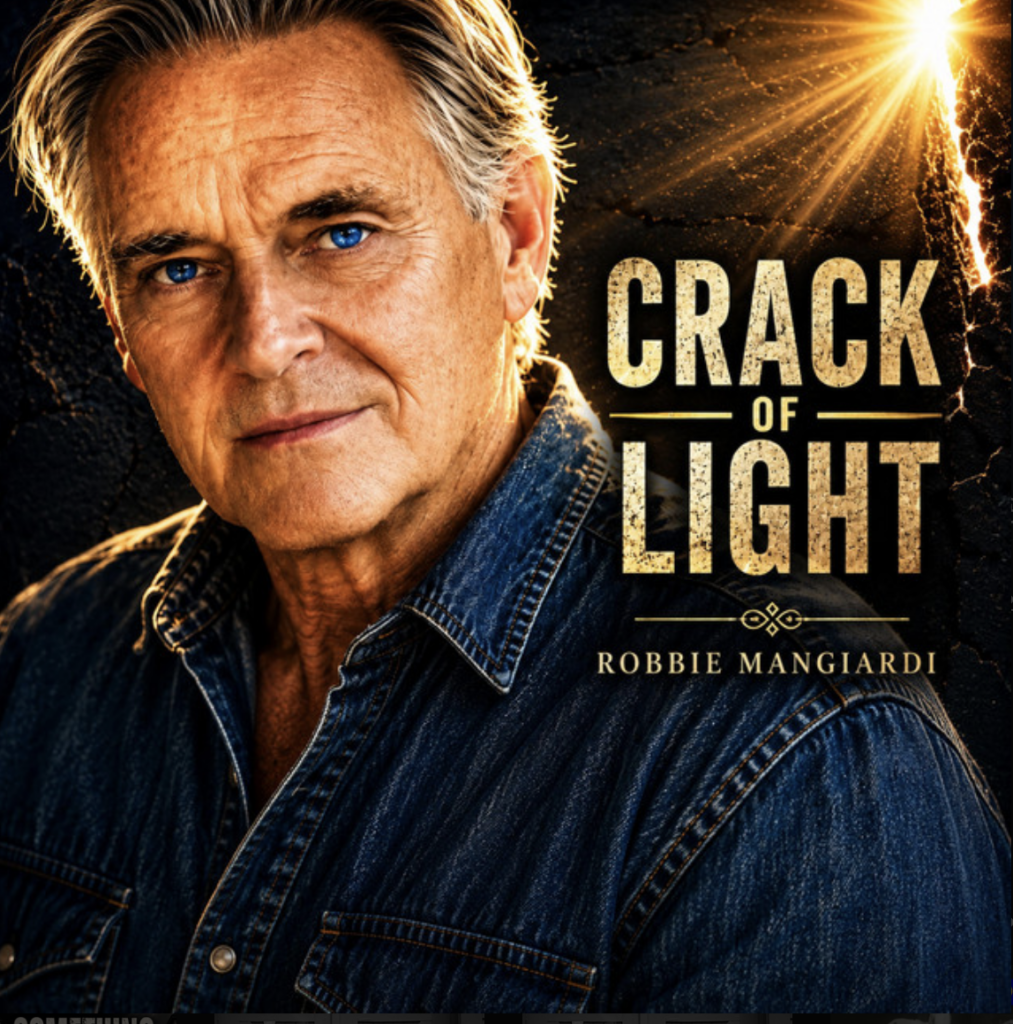
Mangiardi’s own songwriting instincts, shaped by years spent genuinely paying attention to people rather than simply observing them, show clearly in how specifically this song renders its narrator’s interior experience. Rather than reaching for abstract description of sadness in general terms, the lyrics ground themselves in concrete physical detail, eyes checked in a mirror, a head buried in denial, cold rain outside contrasted against the narrator’s own internal blue. That specificity matters enormously for how convincingly the song communicates lived experience rather than theoretical commentary about mental health broadly. Details like remembering himself as a blues boy on the bandstand or recalling bebop drifting through on the radio give the narrator genuine history and texture, someone with an actual accumulated life rather than a generic vessel constructed purely to illustrate a theme.
Following Wayward Wind, which Mangiardi apparently directed outward toward political unease and broader social fracture, Crack of Light represents a deliberate turn inward, and that sequencing choice reveals something about his overall songwriting instincts. Rather than treating personal and political material as entirely separate concerns, moving between outward social commentary and genuinely intimate internal struggle suggests an artist interested in examining difficulty across multiple different scales, comfortable working through both collective and deeply individual versions of the same underlying human vulnerability. Being selected as Song of the Month at Americana Highways by Bill Bentley reflects real critical recognition for this particular turn toward more interior songwriting territory specifically.
Musically, the track moves with genuine patience, something Mangiardi himself has described as functioning almost like a five minute meditation rather than a conventionally structured pop song rushing toward its hook. That pacing choice fits the material considerably well, since depression as lived experience rarely moves quickly or resolves through sudden dramatic shift. Working alongside Martin Flores on production and drums, Rene Camacho on bass, and Neil Rosengarden on keyboards, the arrangement apparently gives the lyric genuine room to breathe and unfold gradually rather than forcing urgency onto material that benefits considerably more from sustained, unhurried attention.
What gives Crack of Light real emotional precision is its refusal to conflate depression with visible collapse. Mangiardi has spoken directly about how someone can be surrounded by genuine friends and still feel miserable underneath that social presence, and the song lives specifically inside that particular tension, the gap between outward functioning and inward difficulty that so much popular representation of mental health struggles tends to flatten or oversimplify. Naming the darkness plainly as bad ideas and foolish pride, rather than reaching for more clinical or elevated language, gives the song genuine honesty about how these thoughts actually present themselves, less like a diagnosis and more like a familiar, unwelcome internal voice that pride keeps someone from acknowledging out loud.
The song’s final verse widens its scope considerably, moving from purely personal reflection toward broader observation, noting both a lonely rich man and someone homeless singing in the street, suggesting genuine difficulty exists across circumstances that might otherwise seem to have nothing in common. That expansion avoids becoming preachy specifically because it stays genuinely tentative, letting the thought turn over rather than arriving at any definitive conclusion, wondering aloud whether some of this depends on how people actually choose to look at things and at each other rather than asserting a fixed answer. That kind of open, considering final gesture fits the song’s overall commitment to honesty over easy resolution.
The accompanying music video, built using AI generated imagery and centered on Mangiardi performing with his Martin acoustic guitar, apparently follows the song’s emotional rhythm rather than constructing any literal narrative to accompany it. That choice makes considerable sense given the material’s actual content, since depression this internally focused rarely translates well into conventional visual storytelling built around plot or clear external events. Letting the video track emotional ebb and flow instead acknowledges something the song itself insists on throughout, that this particular difficulty often exists entirely beneath a surface that continues looking essentially intact from any outside vantage point.
By the time Crack of Light reaches its conclusion, Mangiardi has built something considerably more valuable than simple musical commentary on depression as abstract subject matter. This is a song genuinely interested in recognition rather than rescue, understanding that the actual gift available here is not some tidy solution but simply honest acknowledgment that this particular struggle exists, persists, and does not always announce itself through obvious visible distress. Sometimes the most meaningful thing available is not complete resolution but simply a small crack, some narrow opening letting a little genuine light through the basement door before it closes again, and Mangiardi seems to understand that modest but genuine possibility may be exactly enough.