
An elephant is an unusual guide for an ambient album, and a compelling one. Its presence shifts attention away from our own busy inner monologues toward a living world we often admire without taking much time to consider. Deuter makes that change of focus the starting point for What The Elephant Told, his eight-track album released on September 18, 2026. Inspired partly by his admiration for the Sheldrick Wildlife Trust and its elephants, the record brings animal connection into his longstanding pursuit of contemplative music. The title promises a story, but leaves the listener free to imagine how that story might be communicated.
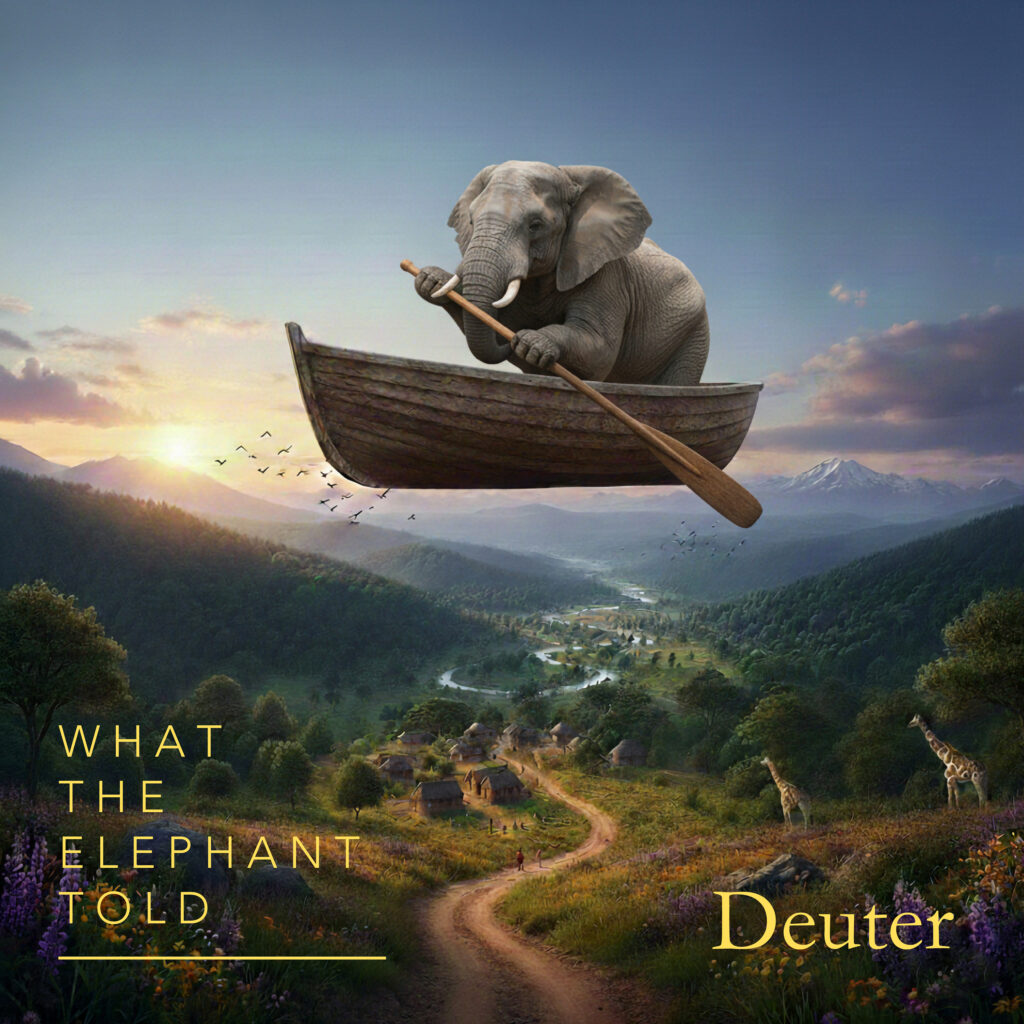
That freedom is central to the album’s appeal. Instrumental music can approach a subject without giving every feeling a name, allowing affection, curiosity and concern to share the same space. Here, the elephant becomes a point of attention around which the listener can gather different associations. There is no need to translate that encounter into a neat lesson before finding something meaningful in it. Deuter’s ambient setting offers an appropriate place for this kind of reflection, with the music intended to support peace and contemplation while keeping its connection to the natural world close at hand.
Cello, synthesizer, violin, oboe, flute and piano form the album’s instrumental palette. It is an inviting combination, bringing bowed strings and breath-led instruments into contact with electronic textures and the familiar presence of a keyboard. These materials give the project several ways to communicate warmth and spaciousness without relying on words. The interest lies in their different characters sharing a common setting, each capable of suggesting a feeling without determining exactly what it should mean. For an album concerned with connections between humans and animals, that openness feels especially appropriate, leaving room for an encounter that language cannot fully organise.
Deuter has released more than sixty albums, making this a new subject within a remarkably sustained musical practice. That experience supplies useful context, although a listener does not need to work through his catalogue to enter this record. His combination of ambient, world and new age music gives the project a familiar foundation, while the elephant inspiration provides a particular focus. There is something appealing about an established artist continuing to direct his attention outward after so many recordings. The creative impulse here comes from admiration and curiosity, qualities that can keep a longstanding musical language open to another chapter.
The opening pair, Kumbukumbu and Mapambazuko, introduces the collection before Nymphaea leads into the title track. Even without treating the names as instructions, the sequence establishes an album with its own vocabulary and a clearly identified centre. Placing What the Elephant Told fourth gives its central image room within the collection rather than making it the immediate entrance. That position encourages the listener to approach the record as a connected experience. Eight tracks are enough to develop an atmosphere without an overwhelming number of stops, making a complete play an accessible way to engage with its subject.
The second half moves through Pollen Path, Ndoto za Tembo and Laini na kubwa before closing with Kumbatio la Tembo. Pollen Path is a particularly evocative name, bringing something small and easily overlooked into an album identified with such a large animal. It suggests a useful breadth of attention, where the natural world includes both an imposing presence and the less obvious processes around it. The tracklist leaves those connections available without spelling out a narrative for every piece. Its imaginative appeal comes from offering points of reference that listeners can carry into their own understanding of the music.
The album title also contains a subtle invitation to reconsider who gets to be the centre of a story. An animal is usually the subject of our descriptions, observations and explanations, yet here it appears as something with a communication worth receiving. That is an attractive perspective for a contemplative record because it asks for receptiveness before interpretation. The listener can spend time with an idea that does not begin and end with personal concerns. Deuter’s interest in human and animal connection gives the release a thoughtful emotional basis, extending its quiet purpose toward the experience of another living being.
His admiration for the Sheldrick Wildlife Trust gives that interest a concrete point of reference. The organisation and its elephants are part of the inspiration behind the album, bringing an actual connection to wildlife into a project that could otherwise remain entirely abstract. That detail helps establish the affection behind the concept without requiring the music to become an explanation of conservation work. It is enough to know that Deuter’s attention has been drawn to these animals and the people who care for them. The record grows from that attention, inviting listeners to make space for a similar curiosity.
For Apricot Magazine, this is the aspect that distinguishes What The Elephant Told from a general promise of calm. The animal connection gives the listener something to think about while the ambient arrangement provides somewhere to do that thinking. Relaxation can be part of the experience, but the subject also leaves room for tenderness and an awareness of life beyond our immediate surroundings. That makes the concept emotionally richer than a simple escape from a demanding day. Its invitation includes returning to the world with more attention, recognising that quiet can help us notice what we routinely pass over.
Deuter’s instrumental background is broad, encompassing flute, guitar, recorder, koto, shakuhachi, sitar, singing bowls, santoor, bouzouki, piano and keyboards. Those instruments belong to his wider practice, while this album identifies its own more specific combination of strings, winds and synthesizer. The distinction is useful because it shows a musician with many available resources choosing a particular palette for this project. A contemplative record benefits from that sense of selection, with the arrangement serving a shared purpose across its pieces. The emphasis on cello, violin, oboe, flute and piano gives the electronic setting an appealing relationship with physical, expressive instruments.
There are several natural ways to spend time with this collection. It could accompany a quiet evening, a period of reflection or a break between obligations, particularly when lyrics would compete with thoughts already asking for attention. A more focused listen offers another possibility, allowing the album’s subject to become part of the experience rather than leaving it in the background. Neither approach requires a special understanding of ambient music. The useful first step is simply to let the sequence unfold, giving its eight pieces enough uninterrupted time to establish a relationship with the room and the listener.
The contemplative intention also extends to the fleeting and less tangible parts of daily experience. Deuter invites attention to nature alongside the metaphysical and ephemeral, leaving the album open to listeners whose responses may be emotional, imaginative or spiritual. That range suits instrumental work because different people can inhabit the same composition without arriving at an identical interpretation. An elephant, a path, a moment of stillness or a passing thought can each become a way in. The music’s setting allows these impressions to remain unfinished, which is often how meaningful encounters exist before we begin explaining them.
What The Elephant Told presents Deuter with a clear subject and an inviting collection of instrumental colours to explore it. Its eight-track format makes the project approachable, while the connection to elephants gives the ambient framework a distinctive emotional purpose. Listeners drawn to reflective instrumental music have a thoughtful point of entry here, especially those who value nature as more than scenery. The album’s most appealing proposition is the possibility of learning to receive something before rushing to describe it. Deuter makes room for that exchange, with a large, quiet presence waiting at the centre of the conversation.


