
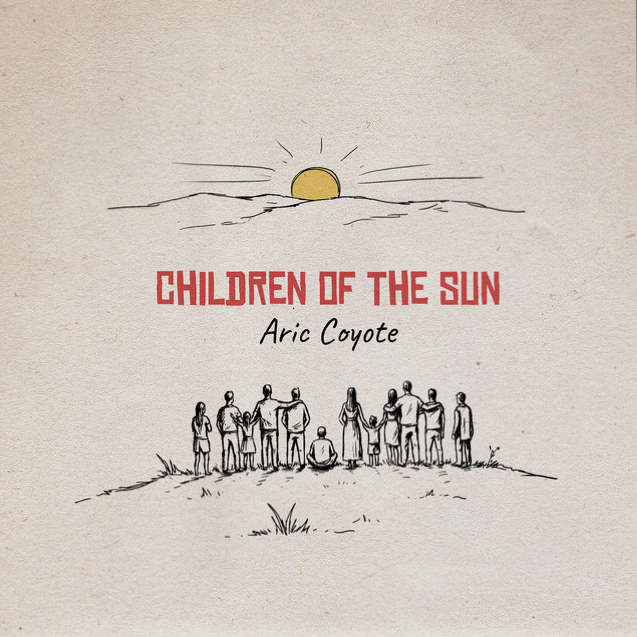
Two acoustic guitars, softly clapped hands and two intertwining voices are modest ingredients for a song carrying such a large wish. Aric Coyote uses them to imagine a future built around acceptance, community and the lives of children who will inherit what we leave behind. That song gives its name to Children of The Sun, the northern California songwriter’s six-track EP, released on September 25, 2026. The title track establishes the collection’s emotional starting point through melody and human closeness. Its hope feels approachable because the arrangement keeps the scale intimate, placing a sweeping aspiration within the reach of ordinary people.
The strongest choice in the title song is that spareness. With only a few elements carrying the performance, the lyric has space to communicate its appeal, while the shared vocal gives the idea of togetherness a musical expression. Handclaps introduce another recognisably human presence, a simple action anyone could join without training or equipment. That detail suits the song’s concern with belonging, making participation part of its character. The arrangement presents community through small, practical gestures, giving the writing a setting that feels consistent with the future it asks listeners to keep imagining and working toward.
Hope is an ambitious subject precisely because it can sound so easy when separated from the work required to sustain it. Coyote’s focus on what we leave for our children gives the title track a useful sense of responsibility. A better future becomes something connected to present choices, with acceptance and shared values providing the foundation. The appeal reaches beyond a private wish to feel reassured, asking people to consider the world that continues after them. That longer view gives the song substance, linking its gentle musical approach to a concern that deserves more than a passing moment of comfort.
The image of being children of the sun also gives the song an accessible centre. It places people beneath something they share, offering a way to think about connection before the divisions that usually occupy attention. There is an appealing humility in that perspective, since the title makes everyone part of the same larger setting. Coyote’s lyrical journey moves between earthly existence and a more spiritual sense of harmony, keeping both possibilities available. The phrase is broad enough to welcome different listeners, while the acoustic arrangement gives that expansive idea a small and tangible place to live.
As an EP, the six-song collection extends outward from that communal opening into a sequence of more personal and evocative titles. Cradle in Your Arms follows Children of the Sun, placing an image of close physical care beside the opening song’s concern for humanity. The relationship between those names is suggestive without requiring an invented account of the second track. A world shaped by acceptance begins with how people treat one another at close range. The sequence offers that association naturally, bringing the scale from a shared future toward the tenderness implied by holding someone safely in your arms.
Empty Lands and Born to Be Free occupy the middle of the tracklist, introducing ideas of space, absence and independence. Those titles broaden the vocabulary around an EP whose opening emphasises peaceful coexistence. Freedom belongs comfortably within that conversation, though it also raises the question of how individual lives fit into a community. The names leave room for listeners to consider those relationships without prescribing a single narrative across all six songs. Together, they give the collection a set of reference points that extends beyond reassurance, suggesting an interest in the places people inhabit and the possibilities they want to preserve.
The final pairing, Summer of Seventeen and Summer Winds, brings the tracklist toward youth, season and memory. Their appeal begins with familiar associations: a particular age, a period that seemed open-ended, and the passing conditions surrounding it. Those images make a fitting counterpoint to the title track’s attention to the generations ahead. Looking toward children’s futures can also remind adults of the possibilities they once imagined for themselves. The sequence allows that connection to emerge through its language, giving the EP an imaginative frame that includes collective hope, personal closeness, freedom and the passage of time.
Coyote’s background provides a credible setting for this kind of songwriting. His musical roots reach through folk and classic rock into new wave, punk and indie rock, with influences drawn from east coast, heartland and west coast artists. That breadth suggests a songwriter whose identity has developed through several musical traditions rather than one tightly defined style. On the title track, the acoustic approach places attention on melody, words and the relationship between voices. It is a clear choice for a song asking for connection, with the arrangement serving the message through direct and familiar musical materials.
During the past decade, Coyote has performed and developed his catalogue in northern California’s dive bars, cafés and open-mic spaces. Those settings give songs opportunities to meet people at close quarters, where a lyric and melody must establish their own connection. His wider writing includes ballads, love songs, meditations and rockers, making this reflective acoustic direction part of a broader practice. The title track’s modest resources fit that history of working through songs in accessible rooms. Its invitation feels suited to an audience gathered within reach of the performer, with two voices and a beat offering enough to begin.
Children of The Sun gives Aric Coyote a clear emotional statement to place at the front of this six-track release. The title song’s two guitars, shared vocals and handclaps bring its humanitarian concern into a form that listeners can readily approach. Around it, the tracklist opens associations with care, freedom, youth and the natural world, offering several ways into the collection. For listeners drawn to melodic acoustic songwriting with an earnest social heart, the EP presents a worthwhile introduction. Its central invitation is simple enough to remember and substantial enough to matter: keep the future in view, and make room for one another.


