Carlton Rara has always been an artist who carries worlds within him. Born in France to a Haitian mother and French father, raised between concert halls and cinema seats, shaped by percussion, poetry, and performance, he has long embodied a borderless artistic spirit. With Universed—a 12-track odyssey released on November 15, 2025—Rara steps into what he calls “a new cycle,” a rebirth driven not by reinvention, but by internal awakening.
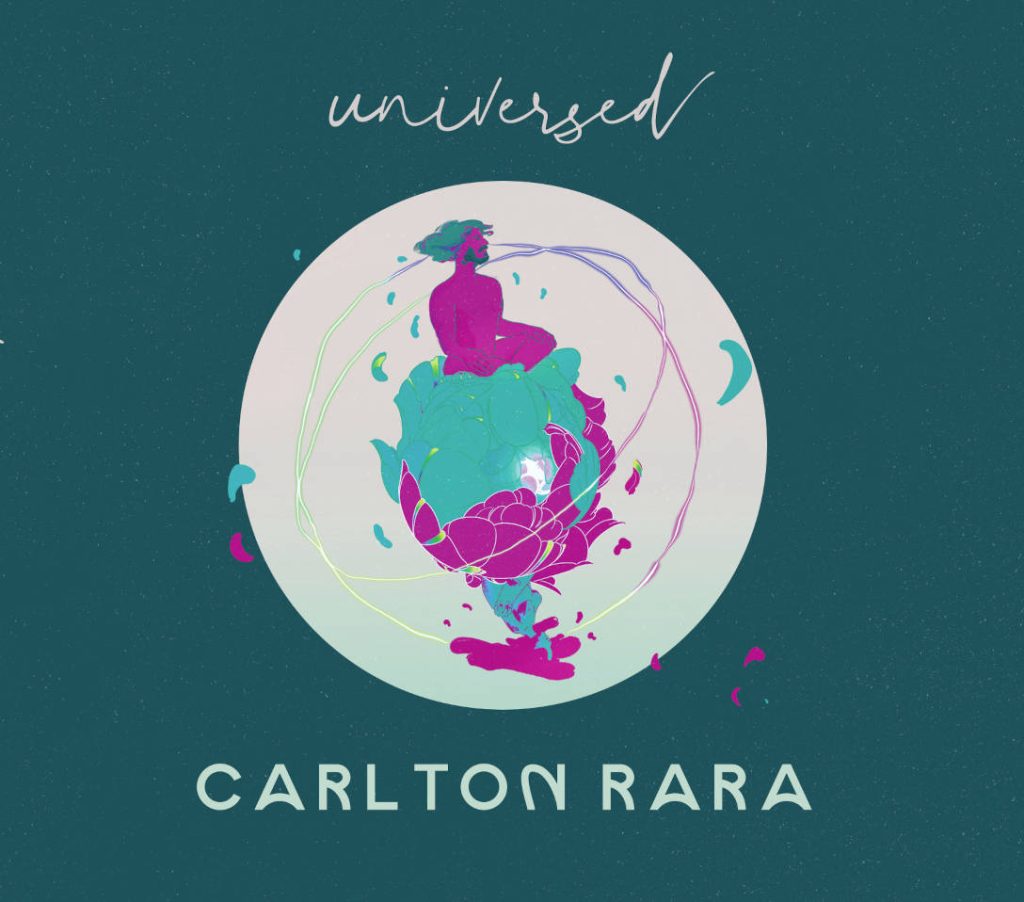
The album is a vibrant fusion of his musical DNA: reggae pulses, blues textures, Haitian traditional rhythms, spiritual meditations, and Creole-English storytelling. Tracks like Poze Zam, Lespri Kolonial la, and Sa Ma fe confront conflict, consciousness, and Haiti’s socio-political reality, while pieces like Today, I Am Being, and Se Konsa Latè a ye open luminous doors to introspection, slowness, and presence. Universed feels like an artist stripping away armor, reconnecting with essence, and offering listeners the same invitation.
Produced, mixed, and co-shaped by Rara—with contributions from guitarist Miguel Castro, bassist Christian Duperray, and master engineer Simon Derasse—the album unfolds like a ritual: percussive, honest, textured, alive. Even its visual world, created by Louh-Ann Alexandrenne and Paula Ambrosio, mirrors its multiplicity.
We sat down with Carlton Rara for an intimate, expansive conversation about transformation, rhythm, spirituality, and the universal human journey reflected in Universed.
Interview with Carlton Rara
Carlton: The transformation comes from within and it therefore reflects on my creativity. Awareness of the present moment and the development of my ability to be present in the now is one of the main changes. Looking from here and now, the Carlton Rara in Peyi Blue or HOME seems to me, like many of us, very much under the influence of the myths of identity and personality. By being more aware of that, I can easily let it go and a whole new field of infinite possibilities opens up for me. This is a true liberation.
Carlton: All these rhythms, pulsations, musical sounds and languages are practices that are familiar to me. I use them as available tools, in my own way.
Carlton: I didn’t really think of placing this track as an introduction. This song chose its place by itself and I thank the intelligence of life for that. Fear, insecurity, often lead us to put ourselves in a protective posture that can quickly turn into an attack posture depending on the vibrational frequency of the emotion that goes through us. If we do not put down our shields or our weapons ready to strike, we remain in a state that prevents all forms of true communication, I mean real exchanges from being to being and even more, we risk destroying what surrounds us by the violence that results from the fact we’re armed. The very fact of arming ourselves is one of the signs of our capacity for violence. The weapons and shields I’m talking about aren’t necessarily physical, which doesn’t make them any less real. Practicing disarmament allows us to connect to our true inner strength and security.
Carlton: Our ability to observe and accept our deep suffering and our ability to experience deep inner joy and peace are intimately linked to each other. Therefore, they cannot be separated. Observing our pain is one of the first steps towards healing and healing naturally leads to feeling the energy of love which is the healing source and love brings us true joy and the light that goes with it.
Carlton: I was almost born in a theater and I spent many evenings of my childhood life attending shows of all genres and disciplines and when I wasn’t at the shows, I was at the movies. I felt very excited about this, I always had the intuition that telling stories, publicly or not, whatever form it takes, was an appointment with life. The whole fabric of my life, whether you put it through the prism of what we call time or not, takes shape in Universed, now, while you are listening to it and it comes to meet your own vibrations.
Carlton: Each of us will become aware or not of her/his role in life; in any case, life invites us to do so in a recurring way. All beings are part of the same whole, an inseparable whole. It seems indeed that musicians, in general, rather have souls of messengers. We have been able to observe this over time.
Carlton: Spirituality and the practices that result from it allow me to reduce the activity of my mind and therefore help me to access a clarity that would not be possible otherwise. Once the vision is clearer, being creative becomes obvious and thanks to the circulation principles, the creative process itself nourishes the vision in return, transforms it, clarifies it more. Staying in the mind sphere can easily give the one who makes the proposal and the one who receives it, the illusion of clarity.
Carlton: Miguel (guitar) and Christian (bass) have fueled the music of Universed with their own energies, their musical skills, their own perceptions of my compositions with both physical and spiritual implications. Simon Derasse brought me security with his ability to listen with care and his know-how in mastering processes. He truly served the mixing while respecting the details of the production choices.
Carlton: This multi-cultural life that I have allows me to observe all the mechanics of the myth of identity and personality. I can see how we constantly confuse our life, that is the fact of being alive, and our living conditions, meaning everything that is external to us and on which our deep beings do not depend. We spend a lot of energy trying to define who or what we are and eventually hang on it and doing so we miss the fact that we are, quite simply, and beings do not have to be something particular to be. To summarize, my multi-culture is just an interface that is quite distinct from my real self and I try more and more to get material within me and not outside.
Carlton: I think you get it, I’m trying more than ever to welcome what the present moment has to offer…so “what’s next” is what’s now. I am continuing the promotion of the album which is a long-term work and which I must honor by giving it all my attention as one brings attention to a newborn. We’ve just started to rehearse to go perform Universed on stage and will soon meet audiences who would like to welcome us (people listen to my music in 52 countries in the world). I’m composing new songs, working on a musical audiobook project and I’m also working on creating a collective space where artists from all disciplines could exchange their ideas on new ways to share their creations and discuss the problems they may encounter in their lives at a time of major changes.
Closing Thoughts
With Universed, Carlton Rara expands—not outward, but inward. The album breathes with cultural memory, spiritual grounding, and rhythmic honesty. It’s a conversation between past and present, body and spirit, suffering and joy—a journey that invites each listener to unarm, to open, and to reconnect with their own universe within.
If you’d like, I can also create a short promo caption, pull quote, or tagline for sharing this interview on Apricot Magazine’s social channels.