
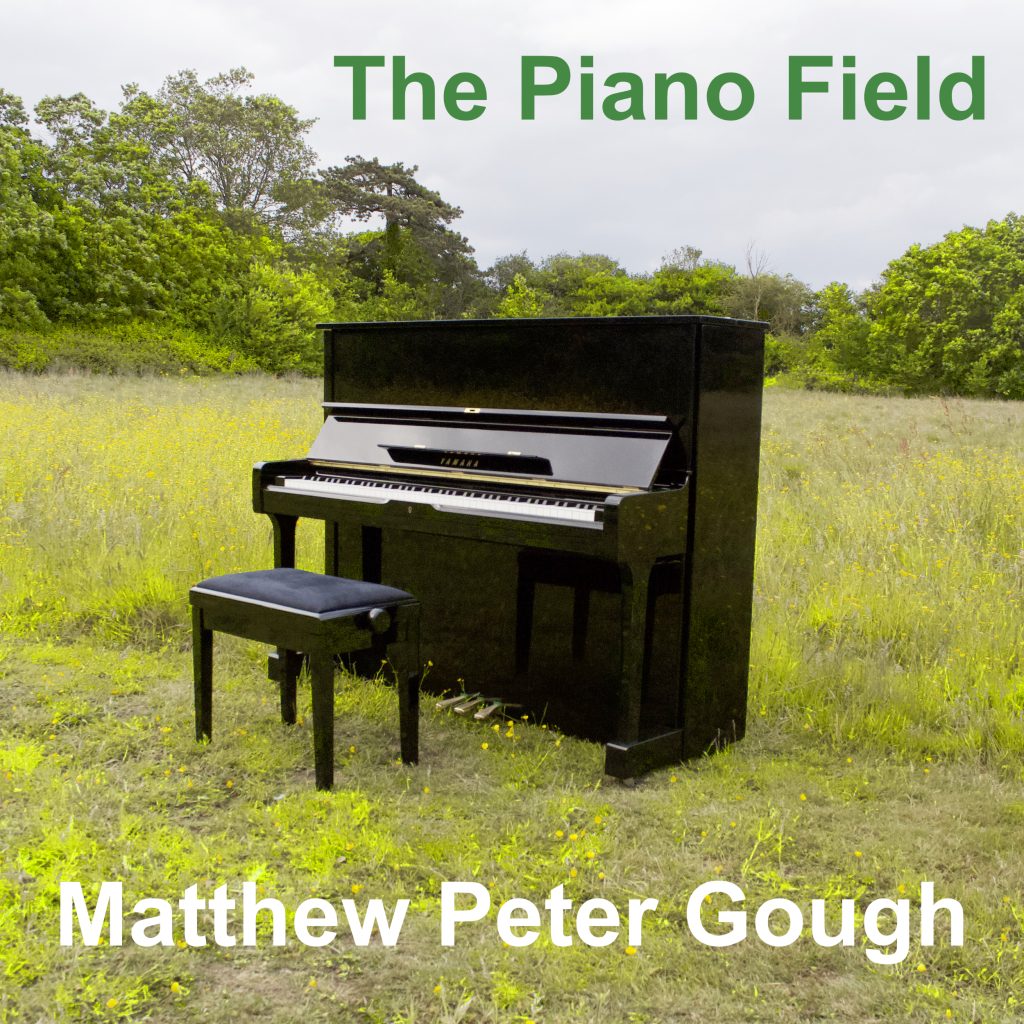
There is a field somewhere near Frinton-on-Sea on the East Coast of England, ordinary by most measures, the kind of place that does not appear on any list of significant landmarks or attract any particular attention from anyone except the person who lives nearby and has been paying it the kind of patient, repeated attention that eventually transforms a place from a location into a source. Matthew Peter Gough has been paying that attention, and The Piano Field, his eleven-track album released May 1, 2026, is the result of someone spending enough time with one beautiful ordinary place to understand what it actually contains. This is not a concept album in the grand thematic sense. It is something quieter and more genuinely ambitious than that, an attempt to capture a complete sensory and emotional experience of a single place across eleven piano pieces, each one a different element of the whole, a different quality of light or movement or life happening within the same field at different moments.
Gough has been making music his entire life in the most literal possible sense. At four years old he was climbing onto his mother’s old battered white piano stool and pressing the keys, captivated by the sounds before he had any understanding of what music notation meant, pretending to read the squiggly dots and lines in the sheet music while actually just listening to what the instrument was telling him. The piano became his escape and his lifeline as he grew up, the instrument he returned to when everything else demanded something from him that he could not give, and his relationship with it eventually became professional enough in its own terms that he qualified as a piano tuner and technician, the kind of intimate technical knowledge of how the instrument works that only comes from a love that goes all the way down through the surface of the thing. When someone who has spent that many years with a piano records an album of piano music, the relationship between the player and the instrument is not a technique but a history, and that history is audible in The Piano Field across every piece.
His previous work, the lullaby music released under the BabyGoodnight brand by Hollywood Trax, established a commercial creative identity built around simplicity and the ability to let the notes breathe rather than demonstrating what the pianist’s hands can do. The Piano Field represents the first time Gough has stepped beyond that identity into more complete and varied piano music, incorporating subtle strings and orchestral embellishments into the arrangements for the first time while retaining the fundamental commitment to simplicity and beauty that has characterized everything he has made. The expansion is deliberate and measured rather than ambitious in the way that can overwhelm what made a smaller thing good, and the result is an album that sounds like the same person reaching a little further while staying grounded in the same values.
The opening title track establishes the field itself as a place and a feeling simultaneously, the piano carrying the warmth of afternoon light on open ground, the melody moving with the kind of unhurried confidence that comes from knowing exactly where you are and finding it sufficient. Gliding High shifts perspective entirely, written from the vantage point of a hawk soaring above the field, the music capturing something of the absolute freedom of that view looking down, the world reduced to pattern and color from a height where the anxieties that accumulate at ground level have no grip. This shift in perspective from human to aerial is one of the album’s most imaginative decisions, the recognition that a field experienced from above and a field experienced from within it are two different places, and both are worth documenting in music.
Clouds Roll By brings the tempo down to the pace of actual cloud-watching, the kind of track that requires the listener to surrender the urgency that most waking hours demand and accept the slower rhythm that lying on grass and watching the sky imposes. The gradually shifting harmonies beneath the melody carry the sense of shapes forming and dissolving that makes cloud-watching the particular kind of meditation it is for anyone who has had the patience and the freedom to indulge it. Buttercup Field arrives with the vibrancy its title promises, the piano carrying something of the visual quality of yellow flowers moving in a breeze, bright and unhurried and entirely present in the moment it is describing, butterflies implied in the lightness of the upper register and birdsong somewhere in the intervals.
Thinking It Through occupies the album’s more reflective interior territory, the quality of a person sitting in a natural environment and allowing the stillness of the place to do what stillness does, which is to let the mind work at its own pace rather than at the pace that external demands typically impose. Sitting in the Garden is one of the album’s most interesting production stories, Gough agonizing over the track for days, trying various effects and additional instruments, before eventually understanding that the answer was to leave the piano completely alone. The unadorned piano that resulted is one of The Piano Field’s most affecting moments precisely because of that restraint, the lesson that the instrument does not always need assistance to say what needs to be said.
River Always Flowing carries the natural metaphor that its title makes explicit, the piano melody moving with the quality of water that has no urgency but also no possibility of stopping, always in the same direction, the rhythm of the accompaniment suggesting current without requiring any imitation of actual water sounds. Mice Play in the Corn is the album’s most charming piece, capturing something of the quality of small purposeful life going about its business at the edge of a field, the kind of activity that is easy to miss and deeply satisfying when you pause long enough to notice it. Pitter Patter is where Gough’s experimentation with echo and delay becomes most apparent and most effective, the pumping of the effect creating the sensation of rain falling, raindrops on a studio window transcribed into production technique and turned into music that sounds like what inspired it.
Quack Quack arrives as a moment of genuine lightness, the natural world that populates the album’s title field including its most immediately recognizable inhabitants alongside the hawks and the mice and the buttercups. End of the Day closes the album with the cello that gradually appears in the arrangement, the orchestral embellishment here doing its most emotionally significant work, the strings adding a quality of gentle conclusion to the day’s final light that the piano alone could not have achieved without them. This is where the careful addition of orchestral elements that Gough introduced into his arrangements for the first time across this album proves its value most completely, the instrument appearing exactly when it is needed and remaining unobtrusive enough until that moment that its arrival carries genuine emotional weight.
The influences that shaped Gough’s piano language, Ludovico Einaudi and Yiruma from the contemporary tradition, Enya’s atmospheric sensibility, the melodic heritage of Chopin and Beethoven, are all present in The Piano Field in the way that long-absorbed influences tend to be present, as invisible structural supports rather than audible surface resemblances. The music sounds like Matthew Peter Gough rather than like anyone else, which is the mark of an artist who has spent long enough with the tradition to have moved past it into something genuinely personal.
The field near Frinton-on-Sea will not appear in any music history. But someone went there with a piano and enough attention to make it last, and the resulting album is the evidence that ordinary beautiful places contain more music than most of us ever stop long enough to hear.


