Some records announce their ambition immediately, and some let it reveal itself slowly across six tracks until the listener realizes they have been somewhere entirely new without ever being told they were traveling. Songs Without Words belongs firmly to the second category. The duo of Gilda Razani and Hanzō Wanning, working under the name About Aphrodite, have built a record that treats genre less as a destination and more as terrain to pass through, moving between Persian folk tradition, jazz phrasing, chamber arrangement, and synth textures with the kind of ease that only comes from artists who never saw those categories as separate rooms in the first place.
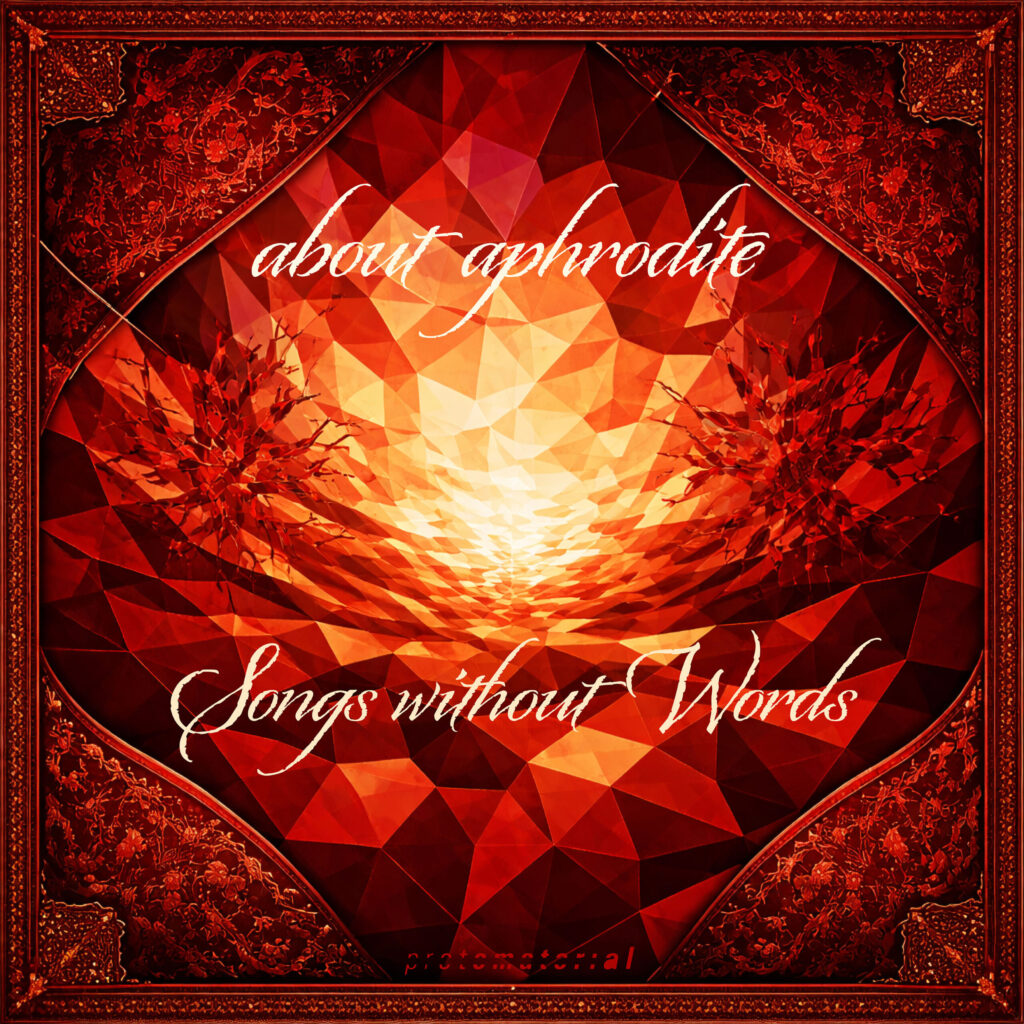
What makes the title an honest description rather than a clever marketing line is how little the album relies on lyrical narrative to carry its emotional weight. Instrumental records built around cultural and folkloric reference points risk becoming purely academic, more interested in demonstrating knowledge than in actually moving a listener, but Songs Without Words avoids that trap by keeping its storytelling embedded directly in the music’s structure and texture rather than in explanation. The album asks listeners to feel their way through meaning rather than read their way through it, which is a considerably harder trick to pull off convincingly, and one this project mostly earns.
Sartschubeh opens the record with a title drawn from the Iranian word for turmeric, tied to the tradition of placing the plant on a newborn’s head for good luck, and that image of blessing and beginning sets the tone for everything that follows without the song needing to spell any of it out. There is a warmth to how the track introduces the album’s core sonic vocabulary, threading Persian folk melodic instinct through jazz adjacent harmonic movement in a way that feels curious rather than showcase driven. It functions less as a statement piece and more as an invitation, easing the listener into a musical language that will keep shifting shape across the rest of the record.
Loretta’s Sinfonia follows with a structural choice that reflects genuine attention to tradition rather than surface level borrowing, built as a two movement piece that begins slow before shifting into something more dance like, mirroring an Iranian musical convention of easing into rhythm rather than launching straight into it. Named for an actual dancer, the track carries a physicality that comes through even without visual accompaniment, the second movement feeling less like a tempo change and more like a body finally allowed to move after sitting still. It is one of the clearest examples on the record of the duo translating a specific cultural framework into instrumental language without flattening it into generic world music shorthand.
Newrusi Cats shifts toward something more playful and communal, drawing from Persian New Year celebrations and the folk belief that spotting small worms emerging from the ground on that day brings particular fortune for the year ahead. There is a lightness here that keeps the album from settling into unbroken solemnity, a reminder that folk tradition carries joy and superstition alongside gravity and ritual. The track’s energy captures something of the celebratory scale being referenced without needing literal sound effects or obvious cultural signifiers to get there, relying instead on rhythmic lift and melodic brightness to suggest festivity.
Taraneh marks the album’s emotional turn toward something heavier, named for a Persian woman whose name translates to melody or sound, and dedicated to telling of a short, courageous life cut down far too early. Without lyrics to state that history directly, the composition carries the weight through restraint, allowing space and tension to suggest loss more effectively than a more explicit musical statement might have. This is where the album’s instrumental approach proves most valuable, since grief handled through implication rather than direct narration often lands with more lasting resonance than something spelled out in words ever could. The track does not ask for tears. It simply holds space for them.
Heroine of the Night, one of the record’s two lead singles, shifts the album into its most atmospheric and nocturnal register, built around the image of a shadow weaver who finds her power in darkness rather than daylight, a quiet guardian moving unseen through a sleeping world. The synth and electronic textures introduced here feel earned rather than tacked on, arriving exactly when the album needs a different kind of sonic language to convey something less rooted in daytime folk tradition and closer to myth. There is a hush to the track that distinguishes it from the record’s earlier, more rhythmically active moments, proof that the duo understands pacing across a full listen rather than just crafting individually strong tracks in isolation.
Reverie closes the record on its most abstract and dreamlike note, built around the sensation of thoughts drifting freely and hidden moments surfacing without warning or explanation. As a closing statement, it makes sense structurally, pulling back from the more grounded cultural specificity of earlier tracks into something closer to pure atmosphere, letting the album exhale rather than conclude with force. That choice to end quietly rather than with a climactic flourish suggests confidence in everything that came before it, an understanding that the record’s cumulative weight does not require a dramatic final gesture to land.
Coming from Protomaterial Records, a Barcelona based label built specifically around artists resisting easy categorization, Songs Without Words fits its home comfortably without feeling like it was engineered to satisfy a label’s aesthetic mandate. The record’s real achievement lies in how naturally its genre blending unfolds, never announcing a fusion so much as simply existing as a singular, coherent musical language built from multiple inherited traditions. Razani and Wanning are not translating Persian folk music for a Western audience, nor are they decorating jazz and chamber composition with borrowed exotic flavor. They are working from somewhere genuinely their own, a space where turmeric blessings and shadow weavers and Persian New Year worms can all coexist inside the same six track world, no passport required, no explanation necessary beyond simply listening closely enough to hear it.