Freeze is not really an album about fear arriving. It is about fear settling in, learning the furniture, changing the temperature of a room, and eventually becoming difficult to separate from memory itself. Across seven connected movements, Adrielle Bow Belle treats paralysis not as weakness but as evidence, the body registering what public language often tries to smooth over with euphemism. Released on July 6, 2026, the record begins inside that physical hesitation, then follows it through private longing, media saturation, inherited danger, and the strange recurrence of history.
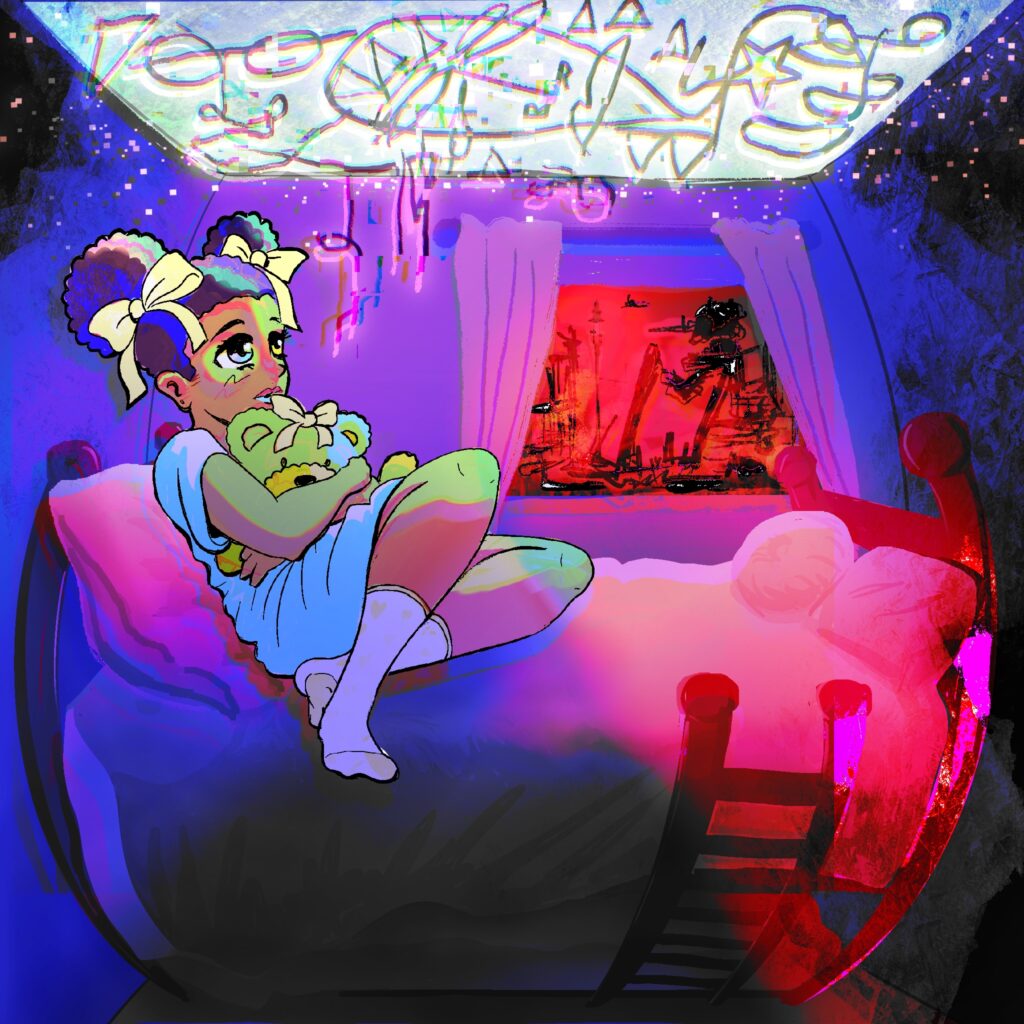
The title carries more than one function, which is part of its intelligence and precision. Freeze names a bodily response, a political condition, and a narrative method, since the album refuses a clean march from cause to consequence. Its nonchronological design moves from the present into earlier wounds and then circles forward again, allowing repetition to become part of the argument. Violence does not stay buried in one decade, and fear does not respect the tidy borders that historians, governments, or families place around events after they have safely passed.
Icey Roads opens the sequence with an image of movement made dangerous by conditions that cannot be fully controlled or predicted. A road usually promises direction, but here it suggests hesitation, misjudgment, and the possibility that every attempt to advance may produce another skid. That tension gives the album its governing metaphor before the broader narrative has even revealed itself. Bow Belle does not need to declare catastrophe at the outset; the unstable surface is enough, because the body already understands what it means to proceed while expecting the ground to betray it.
Come Home Tonight shifts the pressure inward, bringing the album from civic unease toward the emotional vocabulary of waiting and attachment. The title holds domestic warmth and emergency in the same breath, which makes it feel less like an invitation than a plea issued under uncertain circumstances. Within the suite, home is not presented as a guaranteed refuge but as a fragile idea whose meaning depends on who is missing, who is being watched, and who still has the freedom to return. The simplicity of the phrase makes its anxiety harder to dismiss.
Small Talk is an especially sharp placement because ordinary conversation often survives beside disaster without acknowledging it directly. People discuss weather, errands, and plans while larger threats gather just beyond the visible edge of the room, and that social performance can become its own kind of freezing. The song title suggests the language people use when honesty feels unsafe, impolite, or simply too exhausting to sustain. In the album’s design, silence is not emptiness; it is crowded with calculation, self protection, embarrassment, and the private knowledge that something essential is being avoided.
Breaking News expands that avoidance into a public system, where fear is packaged, repeated, and refreshed until urgency becomes routine and consumable. The phrase carries the brittle speed of modern information culture, but Bow Belle places it inside a longer narrative about memory, which changes its meaning. What appears unprecedented on a screen may belong to a pattern already lived by another generation. The album’s resistance to chronological order matters most here, since it refuses the flattering idea that each new crisis arrives without precedent, context, consequence, or responsibility.
Bunker turns toward childhood myth, and that framing is crucial because children often inherit danger first as story, warning, ritual, or game. A bunker can be a shelter, a hiding place, a fantasy fortress, or a sealed room where fear becomes the only available atmosphere. By placing this image after the noise of Breaking News, the album narrows a global emergency into the dimensions of a child’s imagination. The result is not innocence set against politics, but innocence shaped by politics before it has the vocabulary to name what is happening.
Rockets widens the frame again, moving from enclosed shelter toward the distant machinery that makes shelter necessary in the first place. The title is blunt, almost impersonal, yet its position near the end gives it the weight of accumulated human consequence. Bow Belle’s description of the song as a global lament fits the album’s refusal to isolate suffering within a single nation or moment. Still, the suite avoids turning grief into spectacle, because its central question remains bodily and intimate: what happens inside a person when danger becomes both remote and permanently imaginable?
The return of Icey Roads in a cappella form is more than a reprise or a formal bookend. Stripping the closing movement back to the human voice alters the metaphor, because the unstable road is no longer surrounded by whatever protections arrangement can provide. The album ends where it began, but not with the same emotional equipment, certainty, or distance. What first appeared as external danger now feels internalized, carried in breath, memory, and the exposed effort of a voice moving forward without instrumental cover, shelter, or narrative escape.
That circular ending gives Freeze its most persuasive artistic claim and its most durable structural insight. Concept albums often announce coherence through elaborate plot, recurring characters, or obvious symbolic links, but Bow Belle chooses recurrence itself as the binding force. The songs appear less interested in solving fear than in tracing the forms it assumes when history, family, media, and private longing overlap. This approach allows the record to remain politically legible without reducing every movement to a slogan, and it gives the suite enough ambiguity to resist becoming a lecture arranged in seven parts.
The decision to release the album on July 6, the date Anne Frank went into hiding, inevitably places a heavy historical shadow over the work. Such symbolism can become exploitative when used as borrowed gravity, but here it aligns with the album’s sustained concern with concealment, surveillance, displacement, and repeated patterns of fear. The date does not make the music meaningful by itself, nor should it ever do so. Its value lies in sharpening the ethical stakes already present in the album’s structure, especially the insistence that history returns through altered forms rather than exact replicas.
The Grammy and Pulitzer ambitions surrounding Freeze are less interesting than the question of whether the album’s long form design earns serious attention on its own terms. Awards language can flatten art into strategy, especially when categories begin to dictate how a work is discussed before listeners have absorbed its shape. Bow Belle’s record deserves a better conversation, one centered on narrative patience, conceptual discipline, and the refusal to separate social crisis from physical response. Its strongest gesture is not prestige seeking but the commitment to make recurrence audible as an organizing principle with human consequences.
Freeze closes without offering thaw, rescue, or moral reassurance, and that restraint leaves the deepest and strangest mark. The final voice does not stand outside the danger explaining what it meant; it remains on the same uncertain road, carrying everything the intervening songs have uncovered. Bow Belle’s seven movement structure suggests that fear can become inherited knowledge, passed through headlines, homes, shelters, and stories until it feels older than the person experiencing it. What lingers is the image of breath in cold air, briefly visible, proof of life and proof of exposure at once.