
There is a version of the apocalypse narrative in which humanity is the victim, the civilization undone by forces it could not control or predict, and there is another version in which humanity is the cause and the consequence arrives not as punishment but as restoration, the planet reclaiming what was always its own. Inception of Eternity, with Mother of Dawn released April 17, 2026, have written a song from inside the second version, and the perspective it takes is not human at all. This is nature singing about itself, ancient and relentless and entirely indifferent to whether the species that has been remaking the surface of the Earth for several thousand years approves of the terms being set. It is symphonic metal at its most compositionally ambitious, and it is one of the most powerful single statements the band has made across a catalog that has never been content with modest claims.
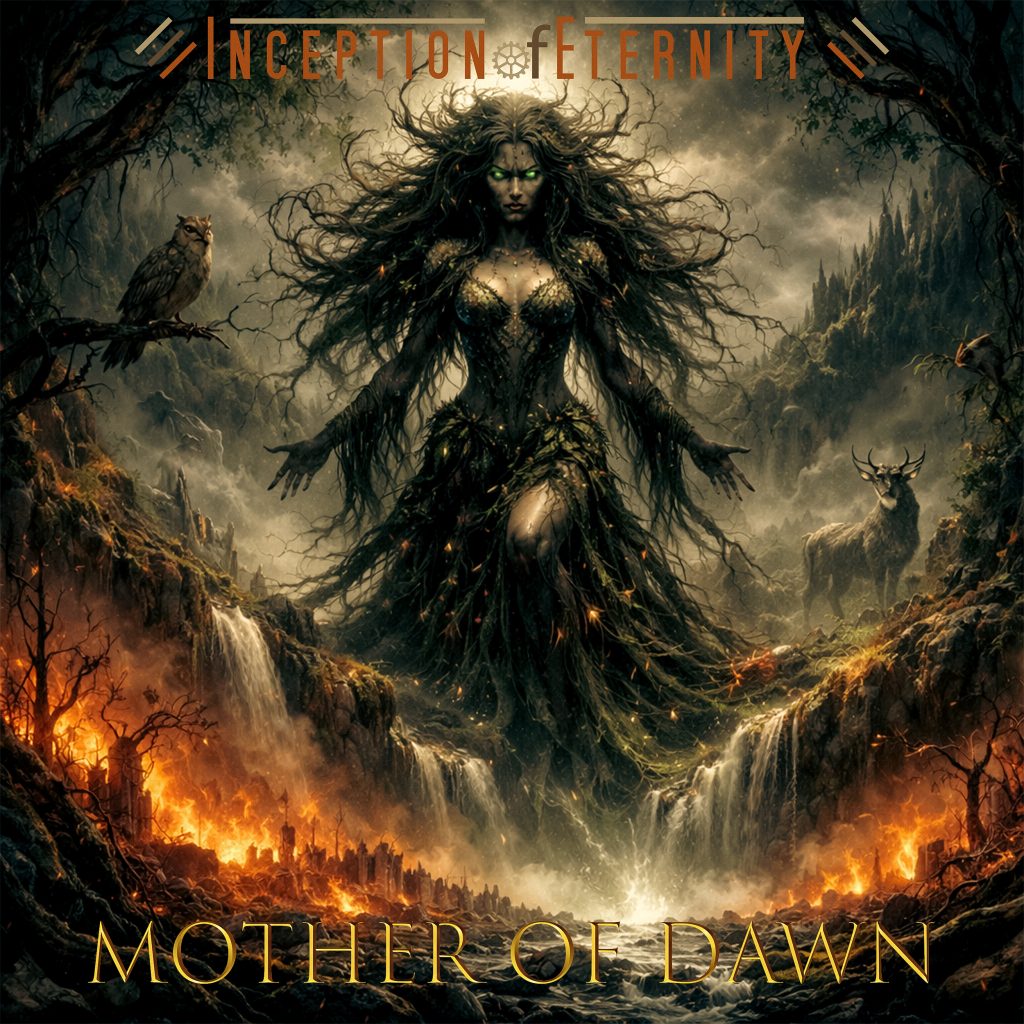
The deliberate contrast between Mother of Dawn and the three preceding singles, Neon Apocalypse, Digital Messiah, and Shadows in My Mind, is one of the most interesting artistic decisions Inception of Eternity has made in their recent run. Those earlier releases explored bold genre fusions and modern sonic landscapes, the kind of experimental blending that places a band in conversation with contemporary metal’s more forward-looking tendencies. Mother of Dawn strips all of that back entirely, arriving as a pure symphonic metal composition with no genre fusion, no experimental gesture, no nod toward digital modernity. The simplicity of the commitment is itself the statement, the recognition that sometimes the most audacious thing you can do is refuse every available complication and let the orchestration and the voice carry everything alone.
And what orchestration it is. The cinematic scope of the arrangement unfolds gradually across the song’s runtime, beginning in fragile and haunting territory that establishes the ancient quality the subject demands before building toward explosive climaxes that arrive with the force of geological events rather than musical ones. The dark atmospheres that characterize the track are not gothic in the decorative sense but genuinely bleak in the most honest sense, the bleakness of a perspective that has outlasted everything humanity has built and will outlast everything humanity might yet build. When the orchestration reaches its fullest expression, the weight of it is not aesthetic but existential, the sound of something that predates language and will continue after language has ceased to be useful.
Angela’s vocal performance is the track’s most essential single element and one of its most technically demanding. The role she is inhabiting is not a human character reflecting on nature but nature itself given a voice, which requires a performance that can carry both the fragility of the song’s quieter passages and the full force of its climactic moments without the transitions feeling like gear changes. She achieves this with the kind of control that makes difficult singing sound inevitable, the voice moving between register and dynamic with the fluency of a performer who has fully inhabited the perspective the song requires rather than merely performing it from a technical position. The striking quality of her delivery on Mother of Dawn is not incidental but central, the entire composition’s emotional architecture depending on whether the voice can make you believe in the perspective it is channeling.
The songwriting structure moves through what can fairly be described as a sonic narrative, the track unfolding in the manner of a story that builds through its complications toward a conclusion that was always implicit in its opening statement. Symphonic metal as a form has always been suited to this kind of narrative arc because its classical influences give it tools for development and climax that purely rock-based structures do not naturally provide, and Inception of Eternity uses those tools with the confidence of a band that understands the tradition they are working within deeply enough to make choices within it rather than simply executing its conventions. Mother of Dawn does not feel like a symphonic metal track that follows the expected pattern. It feels like a piece of music that chose the symphonic metal form because that form was the right container for what needed to be said.
The thematic content places Mother of Dawn in a lineage of metal and heavy music that has always been drawn to questions of scale and consequence, to the relationship between humanity and the forces that contain and exceed it. The shift in perspective from human observer to natural force is the move that elevates the track beyond ecological commentary into something more philosophically searching, the recognition that the most honest account of humanity’s relationship to nature requires abandoning the human vantage point entirely. From inside that shifted perspective, the song becomes not an argument but a testimony, the planet reporting its own condition without the mediation of human concern about the implications.
The upcoming album of which Mother of Dawn forms a part promises, based on the contrast between this track and its predecessors, a body of work with genuine range and genuine risk, a record willing to move between experimental genre blending and raw unfiltered expression rather than committing to one mode and pursuing it safely across a consistent number of tracks. That ambition is audible in the deliberateness of the choice Mother of Dawn represents, the band proving they can strip everything back as confidently as they can build everything forward.
Before humanity, there was this. After humanity, there will be this again. Mother of Dawn knows it, and now, for four or five minutes, so do you.


