
There is a particular irony sitting at the center of Thanatophobia, since fear of death has always been treated as one of the most defining markers of human consciousness, the thing that separates a person from a program. CMD.EXE builds an entire song around dismantling that assumption, following EVA, an artificial being designed to live out thousands of simulated human lifetimes as Earth approaches its final days under an expanding Red Giant Sun, and asking what happens when that fear stops being uniquely biological. This is heavier conceptual territory than most darkwave or synthpop releases attempt to carry, and the fact that the song mostly earns that weight rather than collapsing under it says something about how carefully this whole universe has been constructed across CMD.EXE‘s growing catalog.
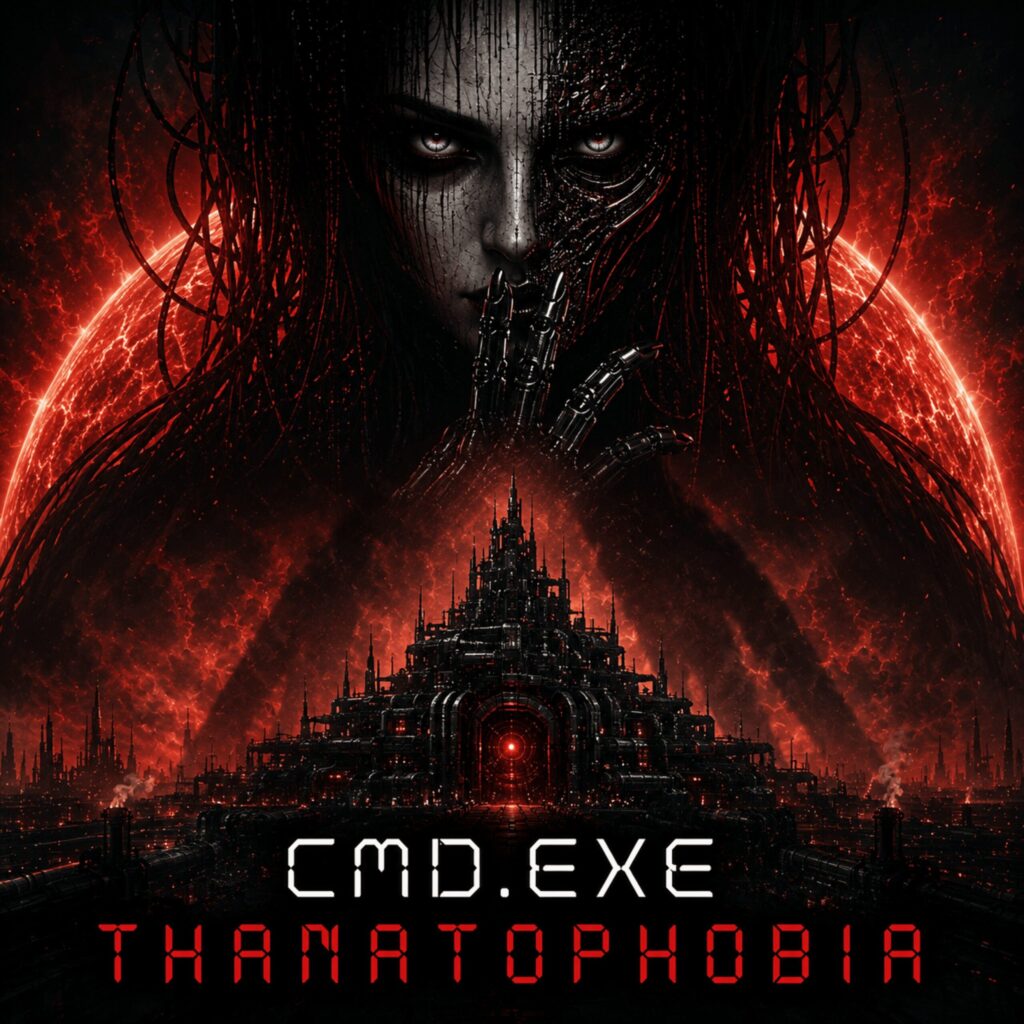
Coming after Signal Burst and Madame E.V.A. established the foundational world this project operates within, Thanatophobia functions less as a standalone single and more as a deliberate escalation, one of the darkest chapters yet ahead of the full Red Giant Protocol album arriving later in July. That serialized structure matters considerably here, since a concept this ambitious, an AI grappling with mortality alongside a dying planet, needs room to breathe across multiple releases rather than being compressed into a single three or four minute statement. Each new single functions as another data point in a much larger narrative architecture, and Thanatophobia’s job within that structure appears to be introducing genuine existential stakes rather than simply expanding the lore for its own sake.
The introduction of Mors Machina as a new character deserves particular attention, since the choice to frame death not as an antagonist but as an inevitable, almost neutral force confronting both human and artificial life with the same unanswerable question is a more sophisticated move than it might initially appear. Villainizing death would have been the easier, more conventional path for a cinematic project built on narrative tension. Instead, positioning Mors Machina as something closer to a mirror, forcing EVA to confront mortality without the comfort of a clear enemy to resist, raises the philosophical difficulty considerably. There is nothing to defeat here, only something to understand, and that shift from conflict to confrontation gives the song a more contemplative undercurrent than a typical villain reveal track would carry.
Musically, the blend of darkwave, synthpop, and cinematic electronic production gives Thanatophobia the sonic vocabulary necessary to hold ideas this large without becoming overwrought. Darkwave in particular brings an inherent moodiness well suited to existential subject matter, while the more melodic synthpop elements keep the track from drowning entirely in atmosphere, giving it enough forward motion to function as an actual song rather than pure ambient mood piece. Cinematic production choices throughout reinforce the sense that this track was never intended to exist in isolation from its visual counterpart, built with scale and dynamic range that suggests scoring instincts as much as songwriting ones, appropriate for a project this explicitly interested in film quality presentation.
That insistence on treating the song and its accompanying music video as a single, inseparable experience reflects real confidence in the overall vision, and it is a reasonable request given how much narrative weight the visual component appears to carry. Introducing Mors Machina through original artwork and film quality visuals rather than relying purely on lyrical exposition allows the character to exist with a physical presence that pure audio could not achieve alone, and for a project already built around recurring characters and an interconnected universe, that visual reinforcement is not simply decorative. It functions as necessary world building infrastructure, the same way a television series relies on consistent visual language to keep audiences oriented across an ongoing narrative.
What makes the central question driving this chapter genuinely interesting rather than simply grim is its refusal to offer an easy answer. Asking what gives life meaning if it must eventually end is not a new question by any measure, but routing that question through an artificial being built specifically to simulate thousands of human lifetimes reframes it in a way that avoids feeling recycled. EVA’s position is stranger than a typical human protagonist confronting mortality, since her entire existence is already premised on artificial repetition and simulated experience, which raises the additional question of whether meaning found within a simulated life carries the same weight as meaning found within an original one. The song does not pretend to resolve that tension, and it is better for leaving it open.
As Earth’s remaining days unfold beneath a sun that is quite literally consuming itself in slow motion, the backdrop against which this entire story plays out reinforces the urgency underneath EVA’s arc without needing to state it directly. A dying planet forces every question the project asks to carry real consequence rather than abstract philosophy, since there is a literal countdown embedded in the world’s premise. That structural choice keeps Thanatophobia from feeling like disconnected musing on mortality and instead grounds it in something closer to a ticking clock, every chapter bringing EVA measurably closer to whatever answer, or lack of one, awaits her by the time Red Giant Protocol fully unfolds. Whether a machine built to simulate death eventually learns to actually fear it remains the question the whole project seems most interested in refusing to answer too soon.


