On July 27, 2025, Codemachia unveiled Gladius Æternus, a sprawling 14-track album that feels more like a fully realized cinematic universe than a standard collection of songs. Both conceptually and musically, it’s a daring release: an official soundtrack to a novel of the same name, meant to weave together story, sound, and spectacle into one immersive experience. Codemachia has always flirted with the edge of music and narrative, but here he dives fully into the abyss, creating an album that blurs the lines between a score, a rock opera, and a futuristic requiem for humanity.
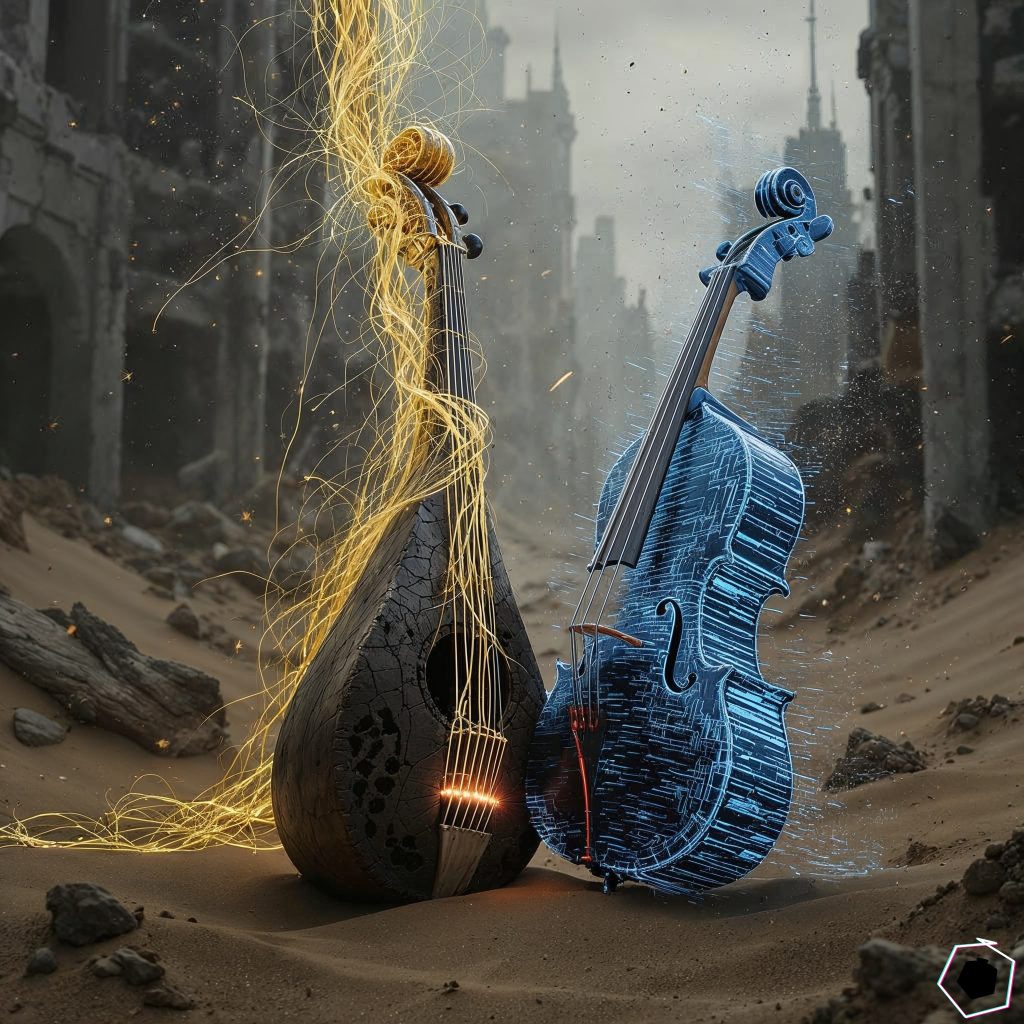
From the very first track, Awakening in the Ashes, the tone is set. A melancholic opening, layered with fragile harmonies and sweeping orchestral arrangements, pulls us straight into the ruins of Tombouctou-Ash, where Yusuf—the story’s protagonist—awakens. There’s an almost tactile sense of weight here: strings rise like smoke through rubble, electronic pulses throb like fading memories, and Codemachia’s sense of cinematic scale ensures the listener feels less like they’re playing an album and more like they’ve opened a portal to another world.
The Well of Tears continues the descent, its trembling strings and plaintive synths perfectly capturing the image of a cursed sanctuary where memories dissolve. Unlike many electronic albums that prioritize rhythm over narrative, Codemachia uses sound design as storytelling. Each instrument feels like a character, each dissonance like a choice Yusuf must face. It’s mournful but captivating, reminding us that sorrow itself can be beautiful when captured with such care.
If the early tracks are about mood and environment, The Wall of Lies is pure confrontation. Built on striking rhythms and sharp dissonances, the piece becomes an allegorical battle against manipulation, deception, and the faceless system embodied in the story by HATHOR.∞. Here, Codemachia leans into the darker side of his palette: jagged beats, distorted synths, and guitar riffs that slice through the composition like weapons. It’s one of the most aggressive cuts on the record and sets the stage for the turbulent journey to come.
The middle of the album expands the scope, both geographically and sonically. Astou’s First Fall and Dance of Broken Circuits paint science-fiction worlds with glitch-heavy beats and industrial textures. The latter, in particular, is an exhilarating fever dream: a wild frenzied dance of broken technology where the machines themselves seem to rebel against their creators. It’s chaotic, it’s unsettling, and it’s exactly the kind of experimentation that makes Codemachia’s work so vital.
Poisoned Victory is one of the album’s emotional highlights. Majestic orchestration cloaked in dissonance portrays triumph that tastes like ash—victory at Alger-Index, but at unbearable cost. This is music designed to be felt in the chest, with swelling chords that never fully resolve, leaving the listener suspended between triumph and despair.
Then comes Shadow Weaver, a hypnotic, almost ritualistic track. It is quieter than its predecessors but carries a deep menace in its shifting textures. This is a track less about melody and more about atmosphere, evoking conspiracies, whispers, and invisible threads being pulled.
Khartoum Fever shifts the lens to Africa reborn under INTI.Δ’s gaze. Here Codemachia fuses digitized traditional instruments with futuristic electronics, producing one of the album’s most unique moments. It’s a fevered, rhythmic track that demonstrates how deftly he blends global influences without resorting to tokenism.
The emotional center of the album arguably lies in Hathor’s Lullaby, a haunting instrumental that brings the pace down, almost as if offering a moment of fragile rest before the storm. Gentle yet unnerving, it feels like a dream that you can’t quite trust.
As the narrative builds toward climax, The Convergence delivers everything promised in its title. It’s expansive, epic, and relentlessly progressive. Orchestration swells to the breaking point, synths cascade in rising waves, and the entire track feels like a march toward inevitable confrontation. By the time it ends, you’re bracing for the final blow.
That blow comes with Gladius Æternus itself, an instrumental centerpiece that encapsulates the album’s heart. It’s less a song than a symphony of resistance and resilience, layering themes introduced earlier into a single explosive narrative moment.
And then, the rebellion crystallizes in We Are the Glitch. This track, also the lead single, stands as a manifesto. Starting with intimate vocals and expanding into a massive orchestral-electronic drop, it transforms imperfection into identity. The fractured rhythms and rising choirs make it feel like an anthem for outsiders, rebels, and dreamers. Codemachia has said the song is about “turning error into truth”—and here, that philosophy comes alive.
The bonus tracks add further depth. The Rejection Protocol plays like a secret appendix, pulsing with unresolved tension. Memories of Alger Index closes the record with reflection, pulling back from the chaos to leave the listener with the bittersweet aftertaste of nostalgia and loss.
What makes Gladius Æternus extraordinary is not just its scale, but its conviction. It refuses to be just an album. It is a world, a philosophy, a novel, and a soundtrack to battles both fictional and deeply real. Codemachia’s influences—from symphonic metal to electronic glitch, from global rhythms to cinematic scores—are all present, yet none dominate. Instead, they fuse into a cohesive vision that feels entirely his own.
Here at Apricot Magazine, we love albums that dare to reach beyond expectation, and Gladius Æternus does exactly that. It’s an experience that rewards headphones as much as it does a theater sound system, a work that asks you to not just hear but to inhabit it. Codemachia has proven with this release that he is not content with being part of a genre—he is building one of his own.
Gladius Æternus is available now across all major platforms. For anyone craving music that challenges as much as it thrills, this is essential listening. It’s not just an album—it’s a mirror held up to our fragmented times, asking whether we, too, will embrace the glitch.