Emerging from the misty underground of Edmonton’s alternative scene, queer singer-songwriter Lezzy Osbourne has returned with her most hypnotic release yet. Black Widow’s Web, unveiled on October 31, 2025, arrives like a spell cast under moonlight—dark, cinematic, and impossible to escape once you’re caught in its threads. The track, followed by a stunning music video premiere on November 7, is both an evolution of Lezzy’s sound and a statement of artistic intent. She’s not merely making music; she’s crafting worlds where desire and danger walk hand in hand.
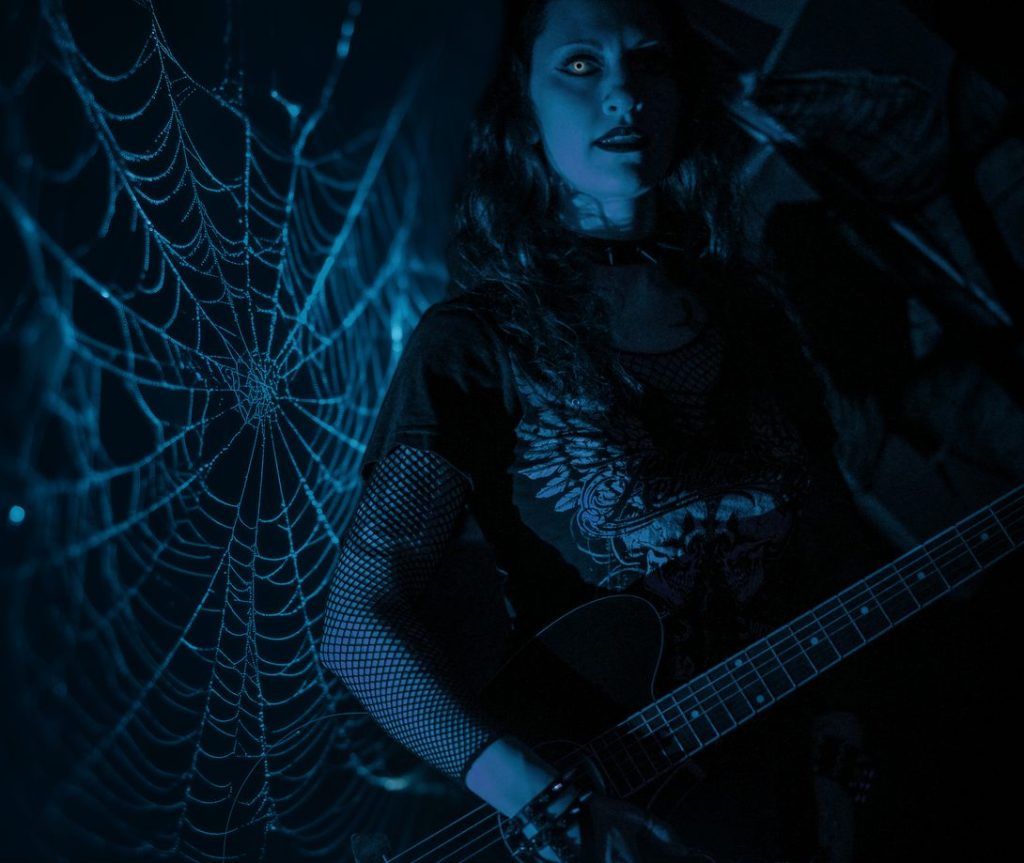
From the very first note, Black Widow’s Web pulls listeners into its eerie beauty. Sparse acoustic guitar lines shimmer with tension, each pluck echoing like a heartbeat in a dimly lit room. Lezzy’s voice drifts between fragility and power, her delivery intimate yet foreboding. The lyrics tell a story of attraction laced with warning—a moment when instinct whispers “run” but the heart leans in closer instead. It’s a tale as old as seduction itself, but in Lezzy’s hands, it feels personal and timeless, told through the voice of someone who has danced with both sides of love’s danger.
What makes the single even more compelling is how completely self-contained it is. Written, recorded, mixed, and mastered by Lezzy Osbourne herself, Black Widow’s Web is a testament to independence and creative vision. Every sound, from the whispering reverb of the guitar to the ghostly layering of her vocals, serves a purpose. The production feels handcrafted—intimate, deliberate, and cinematic. You can almost see the flicker of candlelight in the room where it was made, as though the song itself was conjured in one haunting breath.
If her debut acoustic single Etched Within My Flesh introduced listeners to the raw emotional vulnerability at the heart of her music, Black Widow’s Web reveals something new—a mischievous, shadowy confidence. This isn’t the sound of someone baring their soul for the first time; it’s the sound of someone who has learned to wield their emotions like art. There’s playfulness in the menace, allure in the danger, and beauty in the bite. Lezzy invites her audience to look closer, to explore the gray areas between pleasure and pain, light and darkness, predator and prey.
The accompanying music video, which premiered on November 7, takes the song’s narrative and brings it vividly to life. Drenched in crimson hues and gothic aesthetics, the video unfolds like a short film—a visual poem of temptation, power, and consequence. Lezzy herself appears as the titular black widow, poised between vulnerability and control. The cinematography, rich in symbolic imagery, mirrors the tension of the track perfectly. Every movement, every frame feels like part of an elaborate ritual where seduction and survival blur. It’s as if she has stepped straight out of the shadows of her lyrics and into the viewer’s subconscious.
The release was timed perfectly with Halloween, a season synonymous with transformation, mystery, and the unseen. The campaign surrounding Black Widow’s Web played into this theme, embracing gothic beauty and theatrical storytelling. For fans and newcomers alike, it’s an invitation to step into Lezzy Osbourne’s world—a place where love is never simple and where danger often wears the prettiest face. It’s a fitting metaphor for her artistry: beautiful, unpredictable, and unapologetically bold.
Lezzy’s ability to blend dark folk with cinematic pop sensibilities sets her apart from the crowd. Her sound nods to influences that might range from Fiona Apple’s lyrical honesty to Chelsea Wolfe’s haunting atmospherics, yet it’s unmistakably her own. She builds her songs like stories, treating each one as a confession cloaked in metaphor. Black Widow’s Web isn’t just a song to be heard—it’s one to be felt, unraveling layer by layer until the listener finds themselves caught in its emotional snare.
Beyond its haunting melody and seductive tone, the song carries a deeper resonance. It explores the duality of attraction and destruction, the idea that beauty can be both captivating and fatal. Lezzy turns this theme inward, transforming it into a reflection on power and self-awareness. The spider becomes both villain and victim, the hunter and the haunted. In her world, love is not a safe space but a battlefield of emotion, and she doesn’t shy away from showing its sharp edges.
For Lezzy Osbourne, Black Widow’s Web marks more than a new release—it’s a declaration of artistic identity. Her fearless approach to self-production, her command of atmosphere, and her storytelling instinct position her as one of Canada’s most intriguing emerging voices. Every release feels like a step deeper into a personal mythology she’s building, where vulnerability and strength coexist in perfect tension.
As the final notes of Black Widow’s Web fade, they leave behind an echo that lingers long after the song ends. It’s the sound of an artist coming fully into her own, unafraid to explore the beautiful darkness that defines her music. Lezzy Osbourne has spun something extraordinary—an intimate, gothic masterpiece that seduces, unsettles, and refuses to let go. With this release, she doesn’t just perform her art; she inhabits it completely. And for anyone who dares to listen, escaping her web is no longer an option.