
There is a particular kind of intimacy that comes from stripping an ensemble down to just two instruments, since cello and piano together carry an almost conversational quality that larger orchestral arrangements often struggle to replicate. Souvenir, the new composition from Roman composer Luca Rossetti, leans fully into that intimacy while still reaching for something considerably more expansive, building a piece that carries genuine cinematic scope despite its minimal instrumentation. That combination, chamber music scale paired with widescreen emotional ambition, has apparently become something of a signature approach for Rossetti, whose broader catalog has consistently blended classical elegance with the kind of narrative sweep more commonly associated with film scoring.
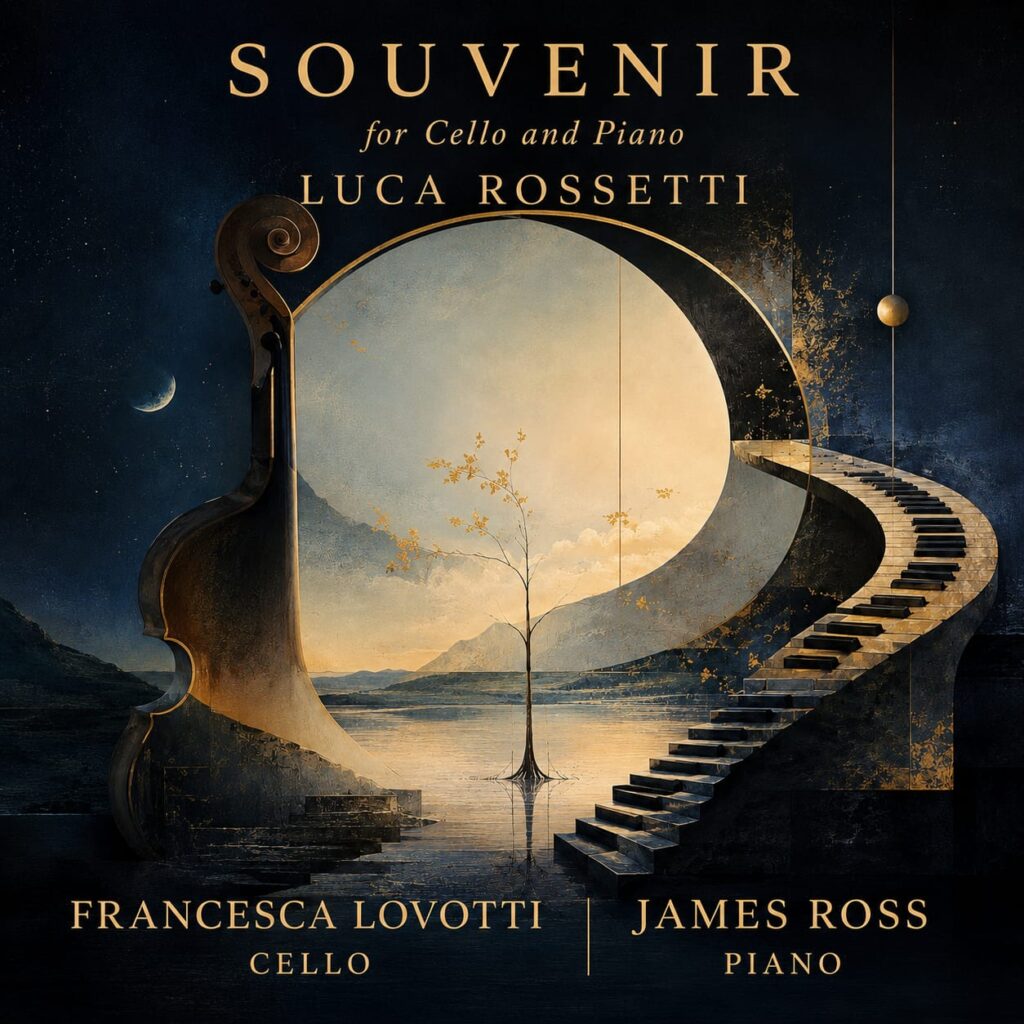
The piece’s title itself, souvenir, suggests something specifically about memory and retained feeling, an object or moment kept as tangible connection to something otherwise passed or distant. That framing gives the composition genuine emotional direction before a single note actually sounds, positioning the music as something concerned with nostalgia and evocation rather than pure abstract technical demonstration. Rossetti has apparently built the piece around sustained dialogue between piano and cello, and that structural choice reinforces the souvenir concept directly, since genuine memory itself often works through exactly this kind of back and forth, one recollection triggering another in continuous conversation rather than arriving as a single fixed, static image.
Performing this composition are two accomplished Roman musicians, both graduates of the prestigious Santa Cecilia Conservatory, giving the recording genuine technical authority behind its emotional ambitions. Cellist Francesca Lovotti brings what has been described as warm, expressive tone specifically credited with lending the entire composition its emotional depth, a quality particularly important for an instrument historically associated with conveying longing and nostalgic feeling more convincingly than perhaps any other in the classical repertoire. The cello’s natural register sits remarkably close to the human vocal range, and that proximity gives skilled cellists genuine capacity to communicate something approaching direct emotional speech, an ability Lovotti’s performance apparently leverages fully throughout the piece.
Pianist James Ross, performing under that stage name while working professionally as Giacomo Rossetti, brings his own considerable interpretive sophistication to the recording, having already developed genuine familiarity with Luca Rossetti’s compositional voice through prior collaborative work together. That existing creative relationship matters considerably for how convincingly Souvenir’s central dialogue between instruments actually functions, since genuine musical conversation depends heavily on performers who already share intuitive understanding of each other’s phrasing and interpretive instincts. Ross’s continued involvement interpreting Rossetti’s catalog has apparently helped extend the composer’s work toward international audiences, suggesting a genuinely productive ongoing artistic partnership rather than a single isolated collaboration.
What distinguishes Souvenir within contemporary instrumental composition specifically is its stated commitment to accessible modern musical language, built around genuinely memorable melodic content and evocative harmonic choices rather than more austere or academically challenging contemporary classical approaches. That accessibility matters considerably for how the piece functions across different listening contexts, since Rossetti’s broader compositional approach has apparently always prioritized genuine emotional communication over technical complexity for its own sake. Drawing narrative construction techniques directly from cinematic scoring traditions gives the piece real structural sophistication while still maintaining the kind of immediate emotional legibility that allows listeners without extensive classical music background to genuinely connect with the material.
The piece’s described epic atmospheric quality, with cello carrying the composition’s most evocative and nostalgic dimensions while piano sustains and amplifies its more orchestral, cinematic character, reveals genuine compositional intelligence about how to divide expressive responsibility between just two instruments effectively. Rather than treating both instruments as functionally interchangeable, Rossetti apparently assigns each specific expressive territory suited to its particular sonic character, letting the cello’s inherently vocal, singing qualities carry direct emotional weight while the piano provides harmonic foundation and structural amplification underneath. That kind of deliberate instrumental role division gives even a minimally scored piece genuine orchestral scope and dimension.
Souvenir arrives as advance preview for Rossetti’s forthcoming full album Beyond Silence, a project apparently combining significant original compositions alongside carefully selected cover interpretations, suggesting a work intended to comprehensively document Rossetti’s overall artistic identity across both his own creative voice and his interpretive relationship with existing repertoire. Positioning this particular piece as opening statement for that considerably larger project gives Souvenir genuine strategic importance beyond its own individual runtime, functioning as introduction to a broader artistic statement still unfolding.
Released through PLAY & Oracle Records under producer Giampaolo Pasquile’s guidance, and distributed globally across every major streaming platform from Spotify through Tidal, Souvenir reaches considerably wider audience access than more traditional classical releases might typically achieve, positioning contemporary instrumental composition within the same accessible distribution infrastructure serving popular music more broadly. That distribution choice reflects real understanding of how contemporary classical and instrumental music actually reaches listeners today, refusing to treat this genre as requiring separate, more specialized access points compared to any other kind of recorded music.
By building Souvenir around genuine dialogue between two exceptionally skilled musicians, and by trusting cinematic narrative structure to carry the piece’s considerable emotional weight without sacrificing melodic accessibility, Rossetti has created something that functions successfully both as standalone chamber composition and as compelling preview for whatever larger artistic statement Beyond Silence will eventually deliver. Lovotti’s expressive cello work and Ross’s refined pianism give this material genuine interpretive depth, ensuring Rossetti’s compositional intentions arrive fully realized rather than merely competently executed, a souvenir genuinely worth carrying forward.


