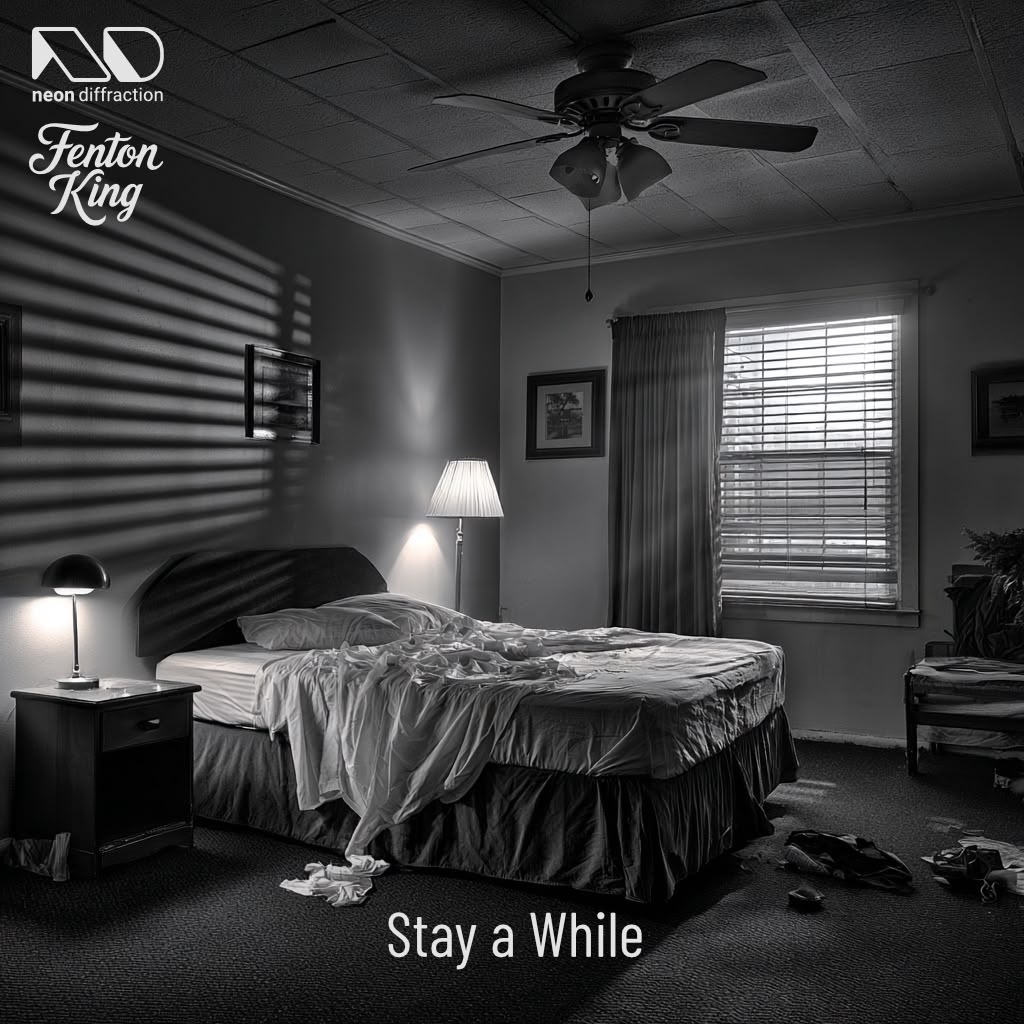
There is a pleasing tension in asking someone to stay while the music keeps moving. Stay a While, released on October 8, 2026, puts that tension to work through the meeting of Neon Diffraction and vocalist Fenton King. Producer Rupert Goddard sets King’s soulful, blues-influenced delivery within liquid drum and bass, bringing rolling breaks and deep bass around a song conceived with the voice at its centre. The pace is 174 BPM, yet the project’s interest lies in making emotional space inside that movement. It is an inviting premise for the beginning of a four-release collaboration.
King, formerly the singer with Sick as Thieves, supplies a vocal identity that gives the partnership a clear starting point. His modern blues phrasing carries an expressive character of its own, and Goddard’s approach allows that character to remain important as the electronic setting takes shape. That decision matters because a voice brings more than melody to a recording. The placement of a phrase, the time taken over a word and the relationship between lines can all influence how a song communicates. Here, the production develops around a singer whose phrasing is part of the material’s appeal.
The emphasis on songwriting provides the most useful way into Neon Diffraction’s intentions. Goddard describes a project built around songs as much as electronic production, and Stay a While gives that principle a specific collaborator. King’s contribution sits within an arrangement designed to accommodate his musical background while placing it somewhere different. The relationship invites attention to how a vocal can retain its expressive shape inside a fast rhythmic framework. There is considerable possibility in that exchange: the drums establish one scale of movement, while the singer can introduce another through the way he inhabits the song.
At 174 BPM, that exchange has a practical challenge attached. Drum and bass supplies substantial momentum, and the arrangement has to make room for a voice without weakening the physical pull of the rhythm. Rolling breaks offer a continuously active foundation, while spacious textures provide a broader setting around them. The deep bass adds weight beneath those moving parts. Taken together, the ingredients establish why liquid drum and bass is a suitable home for this collaboration. Its combination of rhythmic energy and atmosphere gives Goddard several ways to support King’s delivery, with pace and intimacy available within the same frame.
The late-night setting is equally relevant to the project’s identity. Night changes the way familiar surroundings register: a journey feels more private, a room becomes quieter and a thought can occupy more space than it did earlier. Cinematic electronic music often draws on that change of perception, encouraging listeners to imagine a setting beyond their immediate surroundings. Neon Diffraction brings that atmospheric interest into contact with blues and soul, musical languages closely associated with expressive vocal performance. Stay a While introduces the possibility of a personal presence within a larger, more expansive electronic environment.
Its title contributes an appealing sense of scale. Staying a while is a modest request, something that can be asked without knowing what follows. It suggests time shared in the present, leaving the circumstances open. Without claiming a lyrical narrative beyond the information supplied, the phrase gives the release an accessible emotional point of entry. Listeners can bring different experiences to it, from the reluctance to end an evening to the wish for somebody’s continued company. The production’s movement gives that small request an interesting surrounding tension, with the beat continuing even as the title asks for a pause.
The accompanying downtempo mix offers another way to consider the same underlying composition. Because the Original Mix remains the lead version, the release keeps its drum and bass direction clear while allowing the song an alternative setting. That is a worthwhile addition for a collaboration with such a pronounced interest in the vocal. Changing the rhythmic pace can alter how listeners register phrasing, atmosphere and the distance between musical events. The second mix therefore provides more than another item on the release: it invites comparison between two treatments of a shared idea, making the song’s adaptability part of the listening experience.
As the first instalment of a four-part run, Stay a While also establishes a working relationship with room to develop. A series can allow collaborators to discover which details deserve carrying forward and where a later song might need another approach. King’s blues-influenced voice and Goddard’s electronic framework provide continuity without settling every future decision. Released independently through Diffraction Records, the project has a defined creative setting from the outset. The interest now lies in how these musicians continue finding points of contact between vocal expression, atmospheric production and the demands of a rhythm designed to keep bodies moving.
Stay a While gives Neon Diffraction a focused introduction through the choices surrounding its singer. Goddard’s rolling breaks, bass and spacious textures establish the electronic environment, while King brings a voice with its own musical history and expressive priorities. The alternate mix extends that encounter, offering listeners a second perspective before the collaborative series moves on. Most promising is the attention to coexistence: a song can have speed, physical weight and room for somebody to sound close. Neon Diffraction begins this partnership by making those possibilities available together, giving a modest request for time an expansive place to live.