There is a particular cruelty to finding out a song you thought was brand new has actually been sitting in a drawer for four years, fully formed, waiting for its author to catch up to it. Outlaw Cartier‘s when it’s dark out arrives with that kind of quiet unease built into its DNA, a track written in an earlier version of the artist’s life and only now excavated, re-recorded, and set loose as the thematic spine of his current run. It does not sound like a relic. It sounds like something that has been idling this whole time, engine running, waiting for the right decade of its creator’s life to finally floor it.
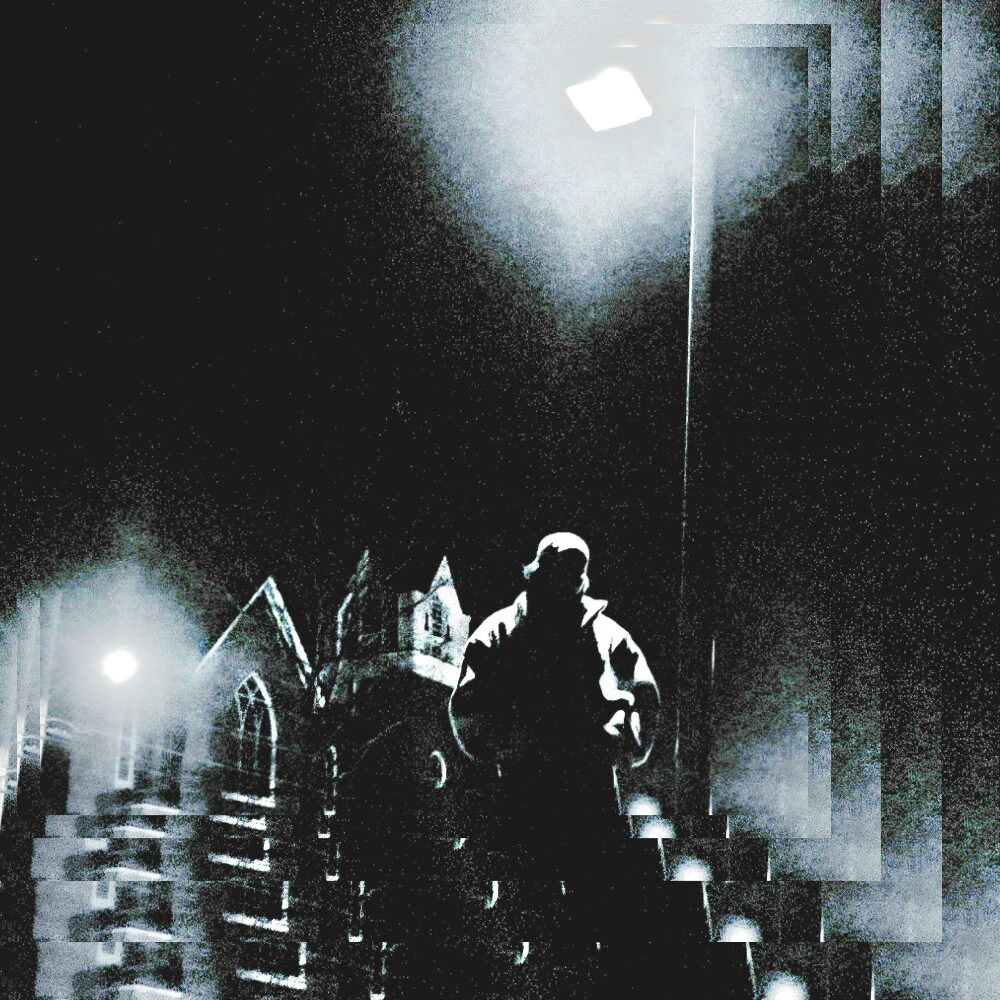
The track opens on the wreckage of a relationship, though it refuses to linger there for long, which is one of its smarter instincts. Rather than settling into the familiar post breakup catalog of grief, it treats heartbreak as ignition rather than destination, the spark that sets off something closer to obsession than sadness. The vocals carry a spacious, almost haunted quality in the verses, as if recorded in a room too big for one person, before the guitars arrive to close that distance violently. This contrast between open air and claustrophobic aggression is where the song locates its actual tension, more than in anything it says outright about the person being left behind.
Structurally, when it’s dark out behaves like a vehicle picking up speed rather than a song building to a chorus in the traditional sense. The rhythm section does not let up once it commits, and that relentlessness becomes the point rather than a production choice layered on top of one. Atmospheric alternative rock often risks becoming static, content to hover in a mood without moving anywhere, but the raw post punk instinct here keeps pulling the track forward, refusing to let the atmosphere calm into something comfortable. It is mood music for someone who cannot afford to sit still, which tracks with the psychological terrain the song is actually mapping.
What makes the song interesting rather than merely intense is its refusal to resolve heartbreak into either forgiveness or bitterness. Instead it pivots toward something stranger, a kind of self reliance that borders on compulsion, the sense of a person who has stopped waiting to be chosen and started choosing themselves with an intensity that edges toward mania. That is a harder emotional target to hit than simple resilience, because it requires the music to sound slightly unstable rather than triumphant. The production mostly succeeds at this, letting the guitars carry an edge of desperation rather than pure catharsis, so the momentum reads as flight as much as forward motion.
There is a version of this narrative, the lone artist grinding through isolation toward some inevitable creative payoff, that risks tipping into cliche if handled without specificity. What keeps when it’s dark out from collapsing into that trap is its insistence on staying inside the discomfort rather than narrating a triumphant escape from it. The song does not claim to have solved anything by its final bars. It ends still moving, still somewhere between the wreckage and whatever comes after, which feels more honest than a tidy resolution would have. Morning light gets mentioned as a kind of clarity, but the track is careful not to oversell what that clarity actually delivers.
Sitting as the anchor to a broader project, the track carries the weight of being both an origin point and a culmination, a song written at the start of an artistic identity now returning to mark its fullest expression so far. That double duty could easily strain a single piece of music, but when it’s dark out mostly holds together under it, in part because it never tries to summarize the whole arc on its own. It functions as a mission statement rather than a victory lap, more interested in describing the shape of the fight than declaring it won. Four years is a long time to sit with an unfinished thought.
What remains most striking is how little the song asks for sympathy. It would have been easy to frame this as a straightforward tale of someone wronged and left to rebuild, but the writing keeps steering toward something closer to unease about its own drive, a suspicion that the very momentum keeping the narrator upright might also be what is quietly hollowing him out. That tension between forward motion and self erosion gives the track its edge, more than the guitars or the rhythm section ever could alone. Whatever got left behind in the dark, the song seems less interested in it than in the person still running from its shadow, four years and one remaster later, engine still not switched off.