
Some songs are meant to entertain, while others are built to disturb, provoke, and ignite difficult conversations. Powers of the Monk’s latest release Bread & Circuses, which dropped on September 5, 2025, is firmly in the latter camp. This is not a safe song. It is not designed to fade quietly into the background or provide a casual soundtrack to daily life. Instead, it demands attention, pulling the listener into the fragmented, surreal, and often terrifying perspective of a schizophrenia patient navigating the blurred line between reality and delusion.
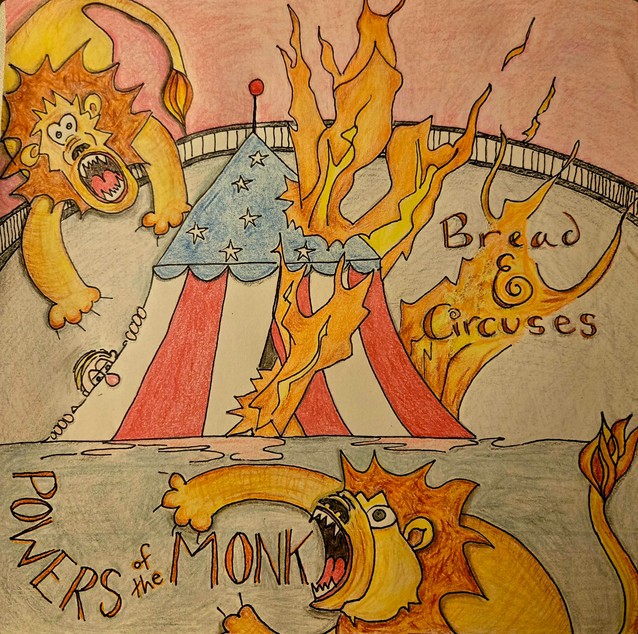
At its heart, Bread & Circuses is a story song, a dark portrait painted with unsettling clarity. The narrative follows a patient whose mind fractures into a vivid hallucination of breaking free from confinement and stumbling into a circus. What unfolds is grotesque and surreal: lions devouring clowns in a grotesque spectacle that feels both horrifying and symbolic. The circus imagery is deliberate, of course, with its long history as a metaphor for societal distraction, absurdity, and chaos. But through the lens of the protagonist’s condition, the imagery takes on a new, deeply disturbing meaning. The lions represent unrestrained violence, the clowns an image of vulnerability turned grotesque, and the circus itself a distorted mirror of a society obsessed with performance even as it crumbles inside.
Musically, Powers of the Monk crafts a soundscape that mirrors the unease of the subject matter. The track opens with a disorienting swirl of guitars and synths, layered in such a way that the listener immediately feels slightly off-balance, as though walking through a funhouse where the mirrors are warped and the lights never quite line up. The rhythm pulses in fits and starts, echoing the instability of a mind trying desperately to hold onto coherence but constantly slipping into chaos. Vocals cut through this texture with an edge that alternates between haunting calm and frantic urgency, a reflection of the protagonist’s mental state.
One of the most powerful aspects of Bread & Circuses is how it refuses to offer easy answers or tidy resolutions. Many songs that tackle mental health themes lean toward healing, resolution, or hope. Powers of the Monk takes the opposite route, inviting listeners to confront the discomfort of delusion and the unpredictability of schizophrenia without smoothing out the edges. The result is a song that feels more like an immersion into an altered reality than a traditional narrative. By the time the lions appear in the lyric, the listener is already so steeped in the atmosphere that the grotesque image feels both shocking and inevitable.
That willingness to lean into discomfort is what makes Bread & Circuses such a compelling addition to Powers of the Monk’s catalog. It demonstrates a commitment to using music as more than just entertainment—it is art designed to unsettle and challenge. The title itself recalls the ancient Roman phrase “bread and circuses,” a critique of how spectacle and distraction can pacify the masses while deeper problems go unresolved. Applied here, it resonates on two levels. On the surface, it reflects the protagonist’s hallucination of a circus spectacle. Beneath that, it offers a commentary on how societies often ignore or trivialize mental illness, distracting themselves with entertainment rather than facing the painful realities that millions of people live with every day.
There is also something undeniably cinematic about the song. The pacing, the imagery, and the relentless tension create the sensation of watching a psychological thriller unfold in real time. Listeners can practically see the cracked walls of the mental facility, hear the echoes of footsteps in a long corridor, feel the sudden freedom of breaking out, and then recoil at the grotesque spectacle of lions tearing into painted clowns. It is the stuff of nightmares, yet its theatricality draws you in, daring you to keep watching even as you want to look away.
What makes the song work, however, is its balance. The band does not sensationalize mental illness, nor does it romanticize it. Instead, they capture a visceral and uncompromising experience that communicates both the horror of the delusion and the humanity of the one experiencing it. This is not a gimmick but an act of artistic empathy, an attempt to bring listeners closer to an experience they may never know firsthand.
Bread & Circuses is not for everyone, and that is precisely its strength. It is not designed to be a radio-friendly pop single or a casual playlist filler. It is a piece of music with teeth, with claws, with shadows that linger long after the track has ended. Powers of the Monk has created something that feels more like a dark short story than a song, an experience that shakes you and makes you think twice about the boundaries between entertainment, mental health, and society’s tendency to look away.
As the final notes fade, listeners are left with a haunting silence, the kind that lingers in the air after a nightmare. It is unsettling, provocative, and unforgettable. In a world full of music designed to distract and pacify, Powers of the Monk has delivered a track that insists on being heard, wrestled with, and remembered. Bread & Circuses is not just a song. It is a confrontation. And once you have stepped into its twisted circus tent, it is impossible to leave unchanged.


