Some albums tell a story from beginning to end. Restraint does something harder, folding eight years of a life into a shape that bends back on itself, so that the record’s first and last songs speak directly to each other across the space of the whole tracklist. Ryan Lester built this album as a mirror rather than a timeline, pairing tracks one and eight, two and seven, three and six, four and five, each pair circling the same wound or the same grace from a different angle. That structural choice alone would be enough to make Restraint worth paying attention to, but what makes it genuinely affecting is how completely Lester earns that architecture through the sheer weight of what actually happened to him.
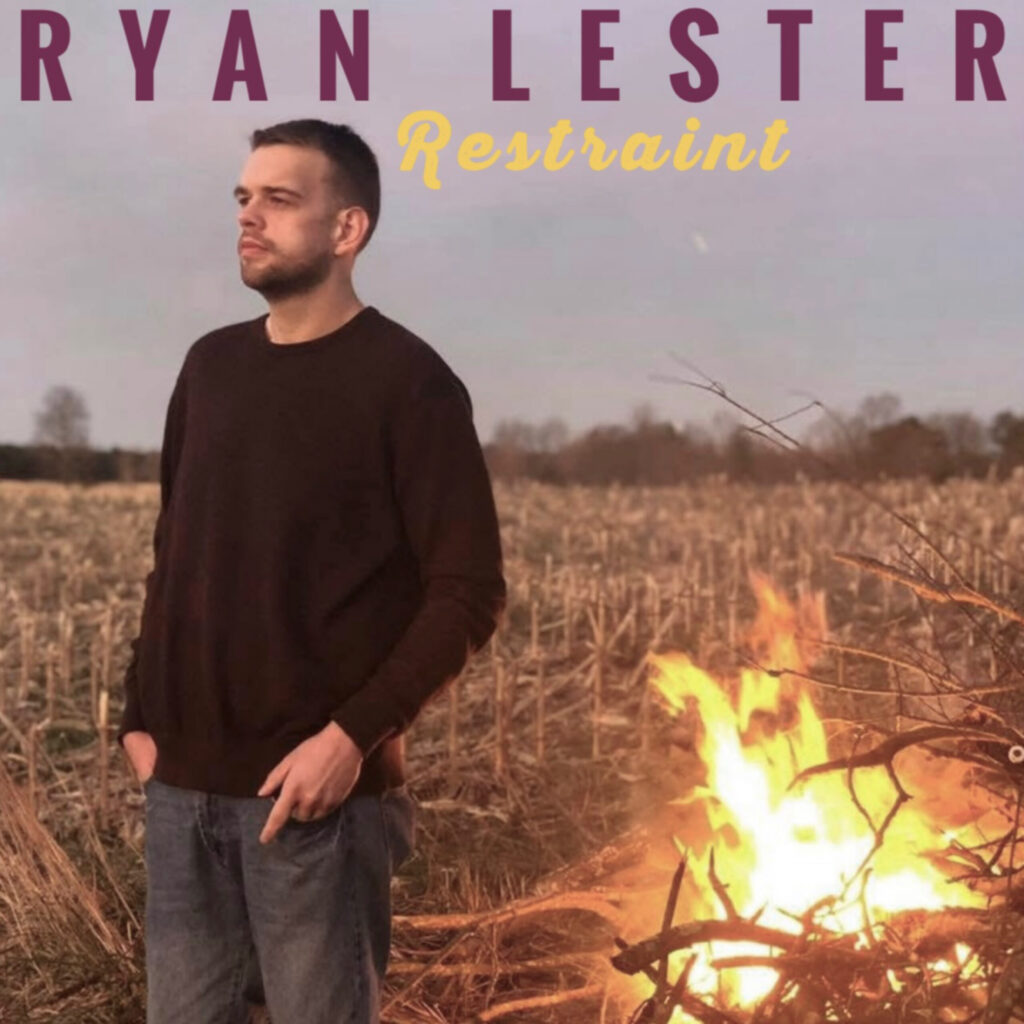
The facts of Lester’s last eight years read like the kind of material most songwriters would need to invent, except none of it is invented here. He quit drinking, lost a hundred and fifty pounds, got engaged, watched that engagement collapse, moved through a string of relationships that did him more harm than good, eventually found something real, got married, and became a father to his son Cyrus. Releasing the album on his eight year sobriety anniversary is not a marketing flourish. It is the actual axis the entire record turns on, and knowing that context changes how every song lands, even the ones that never mention sobriety directly.
Midnight Drive opens the record and, according to Lester, marks the actual starting point of the writing process itself, meaning the album’s opening track is also chronologically where this whole eight year reckoning began. Paired thematically with the closing title track, both songs deal with the consuming nature of addiction, not just to alcohol but to people, to lust, to anything that offers a shortcut to a different state of mind. That is a harder subject to write honestly about than addiction alone, since it requires admitting that getting sober did not automatically solve the underlying hunger driving the behavior. Lester seems unusually willing to sit inside that discomfort rather than resolve it too neatly.
My Brother follows, mirrored later by Love Sick and Lonely, both circling Lester’s pattern of seeking out toxic relationships and the psychological roots underneath that pattern. There is a phrase Lester has used to describe this pairing, the idea of love functioning as its own kind of poison, and that framing gives these songs a clear eyed quality that avoids simple victim narrative. This is not a record blaming other people for damage done. It is a record examining why someone keeps walking toward the same kind of fire, which requires a far more uncomfortable kind of honesty than most breakup songs are willing to attempt.
The Cost of Chaos, paired with Far Away, moves into territory built around the fear of losing someone to forces entirely outside anyone’s control, a theme that reads differently once a listener knows Lester eventually became a husband and father. Fear of loss hits differently after you have something worth losing, and placing these paired tracks symmetrically around the album’s emotional center suggests Lester understood that fear as a constant companion to love rather than something that fades once stability arrives. There is a tension in these songs between gratitude and dread that feels genuinely lived rather than performed, the specific anxiety of someone who spent years watching things fall apart and has not fully unlearned the expectation that they will again.
At the record’s structural heart sit Love Led Me Here and Lullaby For Leaving, described by Lester himself as the sweet center of the album, the closest thing to a happy ending contained within its otherwise unresolved emotional geography. Placing the most hopeful material at the physical middle of the tracklist rather than at the end is a genuinely interesting choice, one that resists the standard redemption arc where struggle resolves into triumph by the final track. Instead, hope sits surrounded on both sides by songs still wrestling with fear and addiction, which feels truer to how recovery and love actually function outside of narrative convenience. Nothing here gets to stay simply happy without complication pressing in from every direction.
Musically, the album draws clear lineage from songwriters like Townes Van Zandt, Jason Isbell, and Tyler Childers, artists whose work has always prioritized lyrical honesty over technical spectacle, and Lester’s commitment to that tradition shows in his insistence on recording everything through real microphones and real instruments, without relying on any digital shortcuts. That choice carries real weight given the album’s subject matter. A record this concerned with authenticity as a lived experience would ring hollow if its actual sound were built on artificial shortcuts, and the decision to record entirely live, with contributions from his wife Aubrey Lester on violin and vocals alongside a small collective of additional musicians, gives the album a warmth and cohesion that feels earned rather than manufactured.
Working entirely out of his own home studio, Matt Cave Studio, also seems to have given Lester the space to trust his own instincts without outside pressure shaping the material into something more commercially conventional. That independence shows in how unflinching the lyrical content remains throughout, since Lester has been direct about the fact that every song here is drawn from actual events rather than fictionalized for effect. Few artists are willing to be this exposed on record, cataloguing not just the sympathetic parts of a personal transformation but the uglier stretches too, the toxic relationships, the substitution of one compulsion for another, the fear that still lingers even after things improve.
What ultimately makes Restraint land as more than a simple redemption narrative is its refusal to let redemption have the final word uncontested. By ending on a track that mirrors the album’s opening meditation on addiction rather than closing on unambiguous triumph, Lester denies himself and the listener an easy resolution. Eight years compressed into eight songs, folded into a mirror rather than stretched into a line, the album insists that growth does not erase what came before it, only sits alongside it, still visible, still worth naming honestly. That refusal to simplify is what makes the album feel less like a story being told and more like a life still being lived, one difficult, hard won day of restraint at a time.