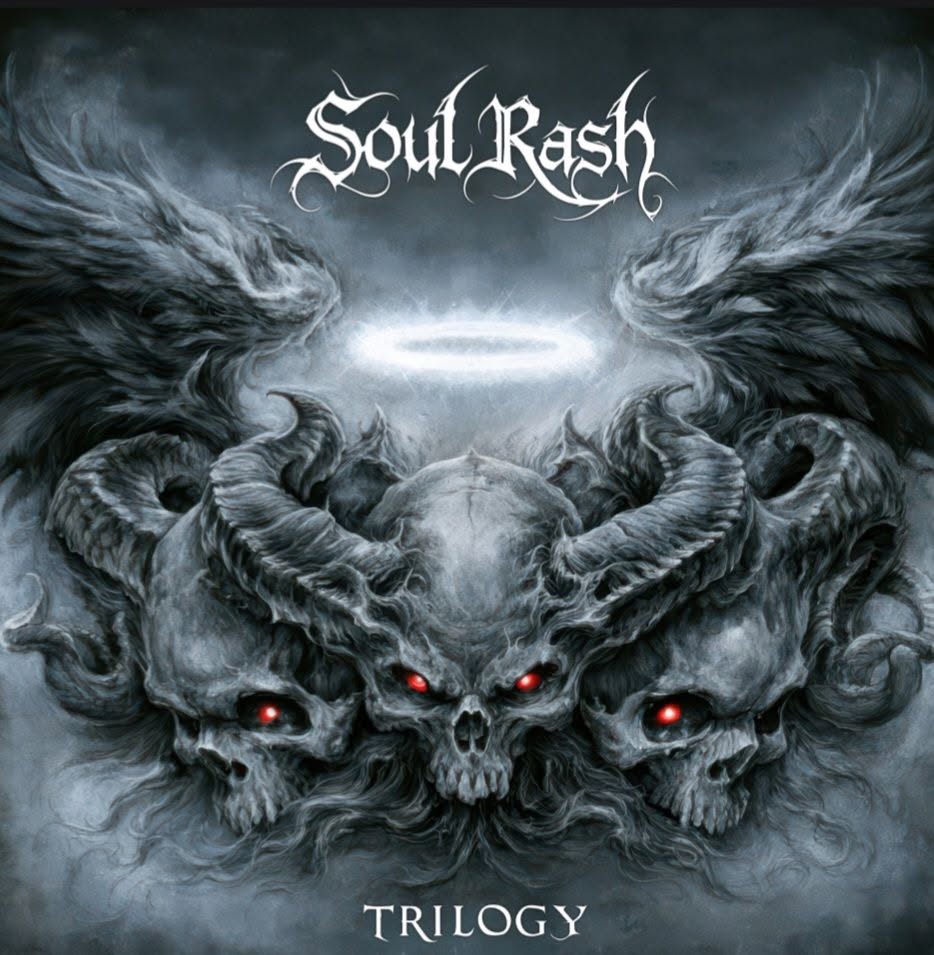
There is a particular kind of intensity that only comes from creative energy being forced to wait, and Trilogy carries that specific pressure in nearly every song. Soul Rash spent three years building this album, with production shut down for close to two of those years while producer Jim Roberts relocated from Colorado to Wyoming and constructed an entirely new studio from scratch. That gap between initial ambition and final execution shows up clearly across the record’s thirteen tracks, not as hesitation or rust, but as accumulated force finally given somewhere to go. This is a band that had years to imagine exactly how big they wanted this album to sound, and Trilogy plays like the sound of that patience finally cashing out.
Divided We Stand opens the record with real intention, and choosing a title carrying obvious tension right at the album’s threshold sets expectations appropriately for what follows. Soul Rash has never hidden their classic rock lineage, drawing openly from acts spanning Black Sabbath to Kansas to Pink Floyd, and that range shows up immediately in how the opening track balances weight and melody rather than choosing one over the other. This is a band with five genuinely seasoned musicians behind it, and that experience translates into an opener confident enough to establish scale without rushing toward its biggest moments too quickly.
Perfect Time follows with what the band has described as a deliberate push toward bigger drum sounds and more bombastic guitar work than their previous two records attempted, and that ambition is audible immediately in how much space the production gives itself to breathe. Recording primarily at Timber Canyon Studios, the destination facility Roberts built specifically for this kind of scale, gave the band access to both a large analog console and a full ProTools HDX setup, and that hybrid approach shows up in a mix that carries warmth alongside real precision. Few studio only projects manage to sound this considered without losing the human looseness that keeps rock music feeling alive rather than mechanically perfect.
The title track Trilogy arrives as a clear thematic anchor, marking the album’s position as the band’s third release and functioning almost as a mission statement for everything Soul Rash has built toward across their catalog. There is a confidence in naming an album directly after its own place within a larger body of work, an acknowledgment that this project understands its own trajectory rather than treating each release as an isolated experiment. The track itself carries real weight appropriate to that positioning, giving listeners a clear sense of a band that has spent considerable time refining exactly what their sound is supposed to accomplish.
Drink With The Devil and Whisky Town both lean into classic rock’s long standing fascination with vice and temptation, familiar territory within the genre but handled here with enough specificity in the arrangements to avoid feeling like pure cliche. Soul To Keep sits between these two tracks and carries a slightly more introspective weight, suggesting a band willing to modulate intensity rather than maintaining a single aggressive register across the entire tracklist. That willingness to vary pacing matters considerably for an album running thirteen tracks deep, since sustained maximalism without any tonal variation tends to numb a listener rather than continuously impress them.
Goodbye offers one of the record’s more emotionally direct moments, a title that suggests departure or loss handled with the kind of straightforward gravity that classic rock traditions have always done well. Fooled You Once follows with a sharper, more confrontational edge, the kind of track built around accumulated grievance finally given voice, fitting comfortably within a catalog of influences that includes bands unafraid of directing real venom toward specific targets. Breeze provides a welcome tonal shift after these heavier tracks, suggesting something lighter and more atmospheric, proof that the album understands the value of contrast even within a project explicitly built around bombast.
I Wouldn’t If I Were You carries an implied warning in its title, the kind of phrase that suggests tension between characters or perspectives, and Hold Out Your Hand shifts toward something that reads as more openly vulnerable, a gesture of reaching rather than confrontation. Lost Inside closes the album’s original material with a title suggesting disorientation or introspection, an appropriate note to strike before the record’s closing statement, giving the tracklist a sense of genuine arc rather than simply stacking songs without regard for sequencing logic.
That closing statement arrives in the form of a cover of Pink Floyd’s Have a Cigar, and the choice carries real thematic weight beyond simple tribute. Soul Rash has made a tradition of including one cover song per album as a nod to their influences, and selecting this particular track, itself a pointed critique of the mainstream music industry’s transactional relationship with artists, feels especially fitting for a band that has explicitly chosen craft over commercial touring, building music entirely from creative passion rather than career calculation. There is a real irony and a real sincerity operating simultaneously here, five professional musicians with decades of touring experience behind them choosing to close their most ambitious studio album with a song about an industry they have deliberately positioned themselves outside of.
What gives Trilogy its actual staying power beyond individual track quality is the sense of genuine investment behind every decision documented in how this record came together. Band members flew into Wyoming multiple times during production specifically to collaborate in person despite operating as a fundamentally studio based project with no touring ambitions, and that willingness to prioritize physical presence and collaboration even without commercial pressure driving the decision speaks to real dedication rather than convenience. Additional sessions took place across multiple studios, from Carriage House in Connecticut to Carney Audio in Rochester, with final mastering completed at Ally Sound in Colorado, a genuinely distributed production process that nonetheless resulted in a record sounding remarkably unified rather than stitched together from disparate sessions.
The band’s own description of their process as making art from air, building something from nothing except what exists in their heads until an indelible recorded work remains, captures something genuine about what Trilogy ultimately represents. This is not an album built around chasing streaming numbers or commercial viability, evidenced clearly by a band that has explicitly acknowledged how little sense their approach makes from a career standpoint while continuing to pursue it anyway. Thirteen tracks and three years later, including nearly two years of forced silence while a studio got built from the ground up, Trilogy stands as proof that sometimes the most bombastic, ambitious work comes precisely from artists who no longer need anything from the industry they are ostensibly part of, only from the music itself and whoever is still out there willing to listen closely enough to find it.