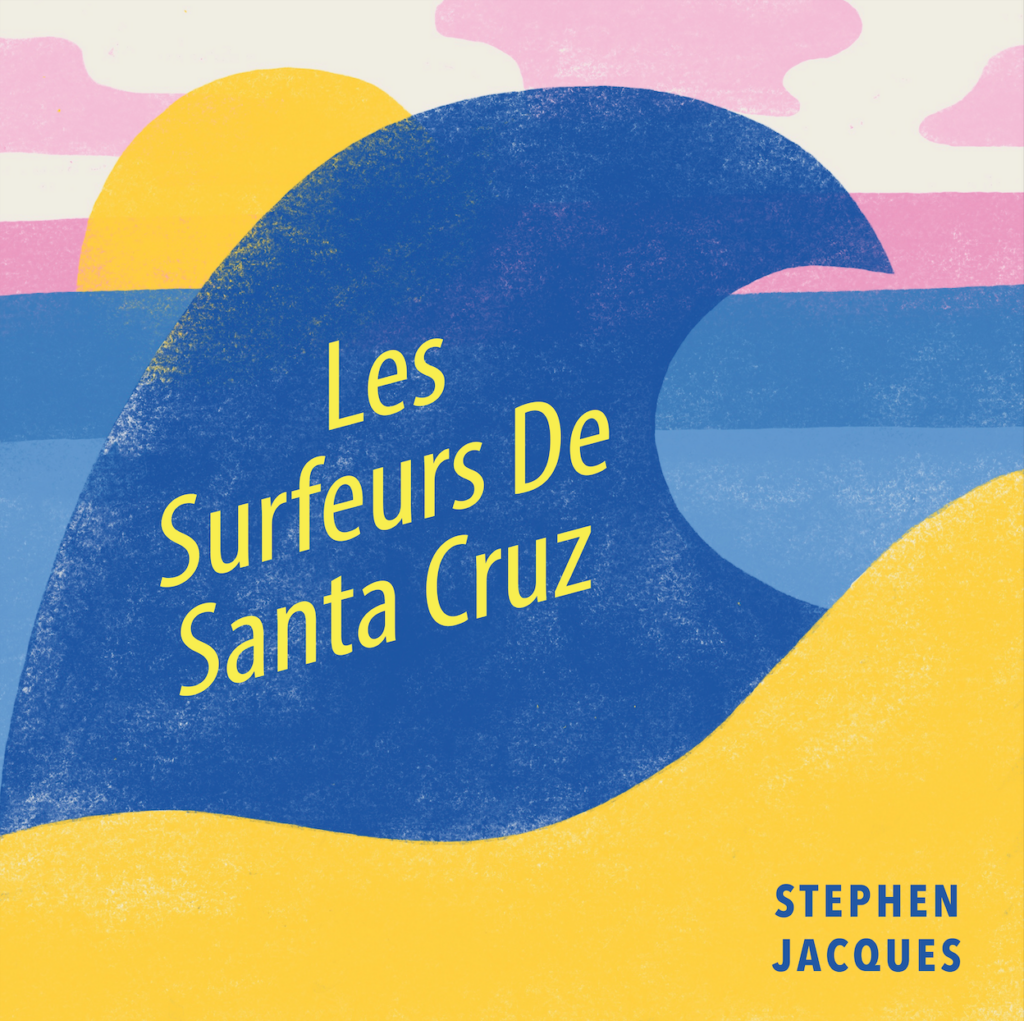
Santa Cruz has always sold two stories at once: sunlight on the water and danger moving beneath it. Stephen Jacques understands that split, and Les Surfeurs De Santa Cruz builds its ten songs inside the distance between postcard beauty and the private calculations required to survive the sea for long. Released on July 3, 2026, the album treats surfing less as lifestyle decoration than as a language of age, risk, loyalty, and memory. Its guitars carry salt and abrasion, while the writing keeps returning to people shaped by waves they can never fully control at all.
Surf Spot Steamer Lane opens with the confidence of someone who knows a famous place can still feel personal. Jacques does not describe the break as a tourist landmark; he presents it as a test where timing, humility, and nerve are measured without mercy on shore. Jason Narducy’s production gives the track rugged forward motion, allowing guitars and rhythm to suggest the force of water without collapsing into surf rock imitation. The song earns its excitement by keeping danger visible, which makes every image of freedom feel temporary, conditional, and therefore more convincing.
She Was the Shoreline turns geography into intimacy, but the title contains a warning. A shoreline appears permanent from a distance, though tide and weather redraw it constantly, and Jacques uses that instability to think about desire. The woman at the song’s center seems less like an object of devotion than a boundary the narrator cannot stop approaching, even when closeness brings erosion. Chris Siebold’s pedal steel is especially suited to this emotional terrain, bending around the vocal like light across water while quietly preserving the ache beneath the romance without protest.
Old Surfer of Santa Cruz gives the album its human anchor. Surf culture often worships youth, speed, and fearless bodies, yet Jacques is more interested in what remains after reflexes slow and local history begins disappearing beneath new money and fresh mythology. The song suggests a life measured not through trophies but through mornings, injuries, weather, and the accumulated knowledge of when not to enter the water. Gerald Dowd’s drumming provides a grounded pulse, giving the character dignity without turning him into a saint carved from driftwood in public.
A Picture in Your Mind moves the record from observed lives toward the unreliable cinema of remembrance. Jacques has always written with a novelist’s interest in scenes, but here he questions the image itself, asking what survives when memory begins editing its own evidence. Vijay Tellis Nayak’s keyboards widen the atmosphere without making the song soft, creating space where details can blur at the edges. The result feels less like nostalgia than suspicion, as though the narrator knows the past has become beautiful partly because it can no longer answer back without protest.
Twin Fin Dreams brings surf craft and private fantasy together with a title that sounds playful until the album’s larger concerns gather around it. The twin fin board belongs to a history of speed, looseness, and altered movement, and Jacques uses that association to imagine escape as something engineered but never guaranteed for anyone. Guitars pull against the rhythm with restless energy, suggesting a rider searching for the exact line between control and improvisation. The song works because it does not explain the dream too neatly; freedom remains tactile, risky, and stubbornly incomplete.
Jacqui’s Surf Thrash is the record’s sudden flash of mischief, aggression, and local personality. Rather than treating the surf world as a solemn brotherhood, Jacques makes room for noise, swagger, and the comic violence of bodies colliding with expectation. The track’s harder attack also prevents the album from settling into one weather pattern, proving that coastal mythology can include abrasion as readily as longing. Narducy keeps the performance sharp without polishing away its mess, and the band sounds briefly less interested in reflection than in kicking sand through the frame that afternoon.
Waves Don’t Lie states the album’s central philosophy with suspicious confidence. The ocean may not lie, but people constantly lie about what happened in it, how brave they were, whom they loved, and why they left. Jacques uses that tension to separate natural force from human storytelling, and the song gains weight from refusing to make purity simple. The water remains honest because it does not care, while the narrator keeps searching for meaning in something that will continue breaking long after every witness has gone home without apology.
Surf Queen’s Barrel shifts attention toward mastery, but Jacques avoids writing a decorative portrait of athletic grace. The barrel is both triumph and enclosure, a brief chamber of moving water where skill and danger become impossible to separate under pressure. Siebold’s guitars give the track a muscular edge, while the rhythm section keeps the motion tight enough to feel earned rather than romanticized. The queen in this song is not crowned by admiration alone; her authority comes from reading pressure, committing at the right instant, and accepting that elegance can exist beside fear.
Surfer’s Sky opens the frame above the water, giving the album one of its most spacious perspectives. After so many songs concerned with bodies, boards, breaks, and memory, the sky introduces scale without offering comfort at dusk. It watches every risk and outlasts every local legend, indifferent to the stories people attach to a particular stretch of coast. Tellis Nayak’s keyboards help the song breathe, but the arrangement never loses the grain of Jacques’ voice, which keeps grandeur tied to someone still standing on earth and measuring the weather alone.
South France Memories closes the album far from Santa Cruz, and that displacement reveals how thoroughly the coast has become an interior place. The final track suggests that surf memory travels across borders, attaching itself to other waters, languages, and versions of youth for years. Jacques does not force California and southern France into one sentimental postcard; he lets distance expose the common ache behind them. A remembered coast is never only landscape, because it contains who was present, what was possible, and which self seemed permanent before time proved otherwise.
Recorded at Steve Albini’s studio with engineer Taylor Hales, the album carries a physical clarity that suits Jacques’ storytelling. The instruments do not appear scrubbed of texture, and the arrangements leave enough roughness for the songs to feel inhabited rather than displayed behind glass in real time. Narducy’s production respects the ensemble, allowing Dowd, Siebold, and Tellis Nayak to shape mood without crowding the narratives. That balance matters across ten tracks, since Jacques is not chasing uniform atmosphere; he is building a coastline where each song encounters the water from another angle.
After twelve albums, including two produced by Albini, Jacques could easily rely on the authority of experience. Instead, Les Surfeurs De Santa Cruz sounds most alive when it admits that experience does not defeat uncertainty; it merely teaches a person how carefully uncertainty must be read before paddling out. The record leaves Steamer Lane, old surfers, vanished lovers, damaged recollections, and foreign shores moving beside one another like sets arriving beyond the horizon. Somewhere after South France Memories fades, another wave forms unseen, carrying no promise except that everyone on land will eventually have to decide whether to enter.