
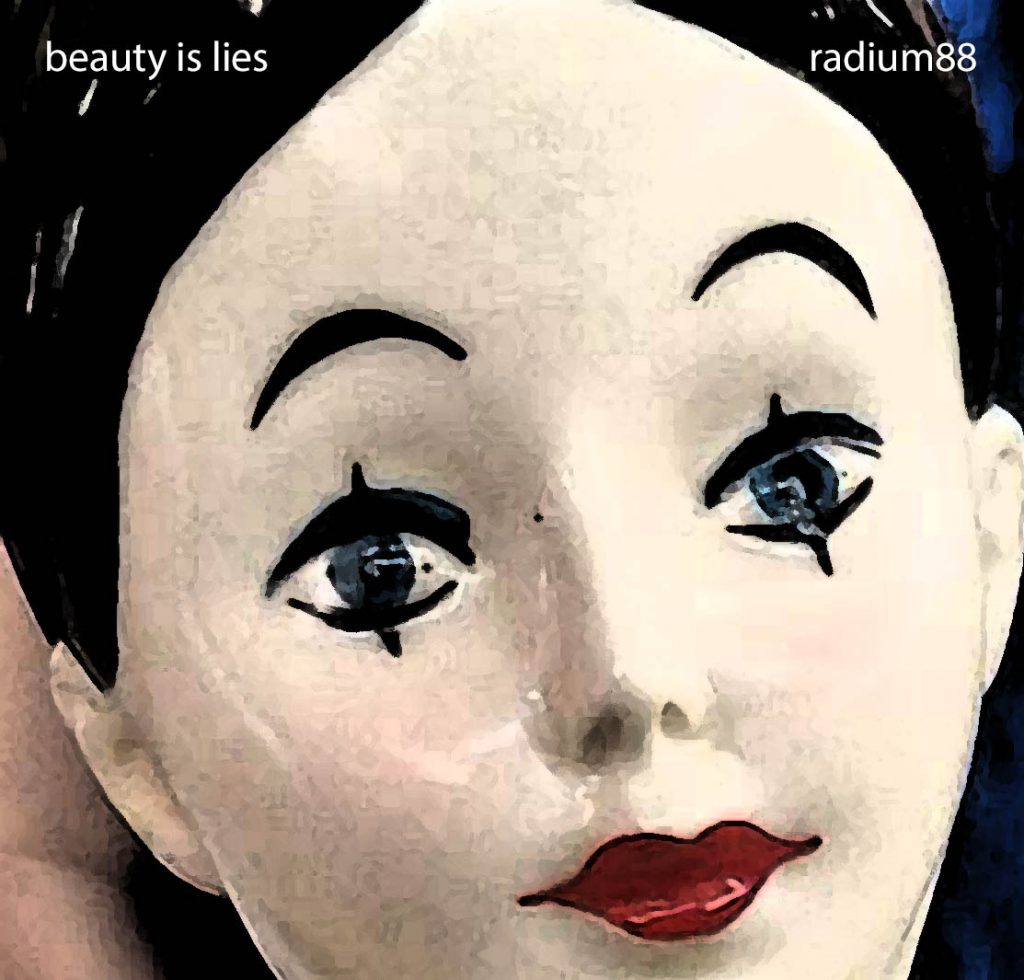
There is a line from Keats that has been quoted so often it has almost lost its meaning, the assertion that beauty is truth and truth beauty, the romantic poet’s declaration that the aesthetic and the real are not merely compatible but identical. Radium88, the Nottingham-based electronic duo now twelve albums into a career that has consistently refused to settle into predictability, have taken that line and turned it inside out. Beauty is Lies, released April 4, 2026, is not a philosophical exercise or a piece of cultural commentary assembled from a safe distance. It is an album about the specific and deeply contemporary experience of living inside a culture that has made its peace with the fake, that has not merely tolerated the artificial but has developed a genuine affection for it, that chooses the convincing simulation over the flawed real thing with increasing consistency and decreasing awareness that a choice is being made at all. This is the twelfth Radium88 album, and it sounds like the one they have been building toward.
The sonic range across Beauty is Lies is genuinely ambitious, moving between territories that most projects would treat as incompatible, and the movement feels organic rather than eclectic for its own sake. Epic synth architectures sit alongside accordion and whistle with the ease of a duo that has spent decades developing the internal logic that makes such combinations coherent rather than jarring. The Sigur Ros influence manifests in the album’s grandeur, its willingness to let a sound expand to fill a very large space before introducing the next element. The Vangelis inheritance shows in the cinematic sweep of the keyboard work, the sense that the music is scoring something larger than itself. New Order and Massive Attack provide the rhythmic intelligence, the understanding that electronic grooves can carry emotional complexity rather than simply providing dance floor momentum. And the neo-classical piano influenced by Glass, Richter, and Einaudi adds a dimension of restraint and formal beauty that counterbalances the album’s more expansive tendencies. None of these influences announce themselves. They inform from underneath, the way long-absorbed lessons tend to do.
Behold! opens the album with the quality of a curtain being pulled back, a gesture of presentation that is both invitation and challenge, the title’s exclamation mark carrying a note of irony that sets the album’s tone immediately. Something is being shown to you, and the question the album is asking from the first moment is whether you can trust what you are seeing. In Transit, In Motion (planetary) follows with a sense of scale that earns its parenthetical qualification, the track moving between the intimate and the genuinely cosmic in a way that mirrors the album’s broader movement between the personal and the cultural. The planetary suffix suggests that what is being described is not merely an individual experience of disorientation but something operating at a much larger radius, the loss of truth as a shared cultural reference point rather than merely a personal failure.
Blindside (simplified) arrives with its own parenthetical that does something slightly different, the simplification not of the music but of the experience being described, the particular way that deception works by reducing complexity to something easier to accept. Code Red follows with the urgency its title implies, the album’s more post-punk electronica dimensions becoming apparent in the rhythmic energy and the emotional directness of the track. This partial return to Radium88’s earlier roots is one of Beauty is Lies’ most interesting structural decisions, the duo reaching back into their own history at the same moment the album is examining a culture’s problematic relationship to the past, the nostalgia that makes fakes feel like truths because they resemble things we once valued.
Bad Faith is the album’s most politically pointed title and one of its most carefully constructed tracks, the bad faith of the title describing not merely individual dishonesty but the systemic kind, the kind that operates as policy and infrastructure rather than as personal failing. Until One Lonely Starless Night carries the album into its most atmospheric territory, the absence of stars functioning as a metaphor for the absence of fixed reference points, the darkness that results from losing the navigational certainty that truth once provided. This is Radium88 at their most Sigur Ros-adjacent, the sound expanding into something that feels genuinely vast and genuinely lonely simultaneously.
Les Rêves Perdus de Demain, the French title translating roughly as the lost dreams of tomorrow, introduces the album’s most explicitly European sensibility, a reminder that the cultural condition Beauty is Lies is examining is not geographically specific but shared across the contexts where the artificial has been allowed to substitute for the real. The angelic vocals and spoken word elements that appear across the album find some of their most effective deployment here, the voice becoming another instrument in the duo’s orchestration rather than a conventional lead element. Shadow of the Uncanny Valley is the album’s conceptually sharpest track, taking its title from the robotics and CGI concept describing the specific discomfort produced by things that are almost but not quite human, the particular horror of the convincing simulation, and building a piece of music that creates exactly that quality of almost-recognition and slight wrongness in the listener.
The title track Beauty is Lies arrives at the album’s emotional and thematic center with the weight of everything that has preceded it, the accumulated evidence of the album’s argument delivered in its most concentrated form. This is the track where Keats meets the present moment most directly, the romantic equation of beauty and truth inverted to describe a contemporary reality where beauty and lies have become the operative pair, where the attractive and the false have developed a relationship so close they are frequently indistinguishable. The piano carries much of this track’s emotional weight, the neo-classical influence most apparent and most affecting here, a formal beauty being used to describe the betrayal of beauty’s original promise.
We Close Our Eyes serves as a meditation on complicity, on the voluntary nature of much contemporary self-deception, the eyes closed not because the truth is invisible but because keeping them open has become uncomfortable. There is no anger in the track toward this willingness, only a kind of clear-eyed recognition that it is the default human response to an environment saturated with attractive falsehoods, that looking away is not weakness but exhaustion. All You Know (empirical) closes the album with its final parenthetical qualification, the empirical knowledge of the title being exactly what the album has been questioning across eleven tracks, the reliability of what can be observed and verified in a cultural moment where observation itself has been compromised by the sophistication of what is being fabricated.
Beauty is Lies is a twelve-album-deep act of artistic urgency from a duo that has earned the right to make urgent art without it feeling like posturing. Radium88 are not young artists discovering that the world is more complicated than it appeared. They are experienced artists who have watched a specific deterioration happen over time and have made the album that the moment required from them. The synths are epic. The accordion is real. The piano is beautiful. And the whole thing is, in the best possible sense, telling you the truth about lies.
Keats was not wrong. He simply could not have imagined what we would do with his equation once we got our hands on it.


