There is a thought that, once it arrives, becomes difficult to fully dismiss, the possibility that every decision you have ever made and every path you have ever chosen and every act of rebellion you have ever committed was already part of a design older and larger than yourself, that the freedom you experience is a beautiful illusion concealing a deeper determinism. Most people never notice the pattern, some call it fate and some call it coincidence, and most go their entire lives without confronting the terrifying question directly. Watch Me Die Inside, the project of the artist known as Aleph, confronts it head-on with the latest Fragment, Die Gestalt der Fügung verharrt unverrückt, released June 1, 2026, a track that transforms philosophical dread into sound and asks the listener not to believe but simply to look closer.
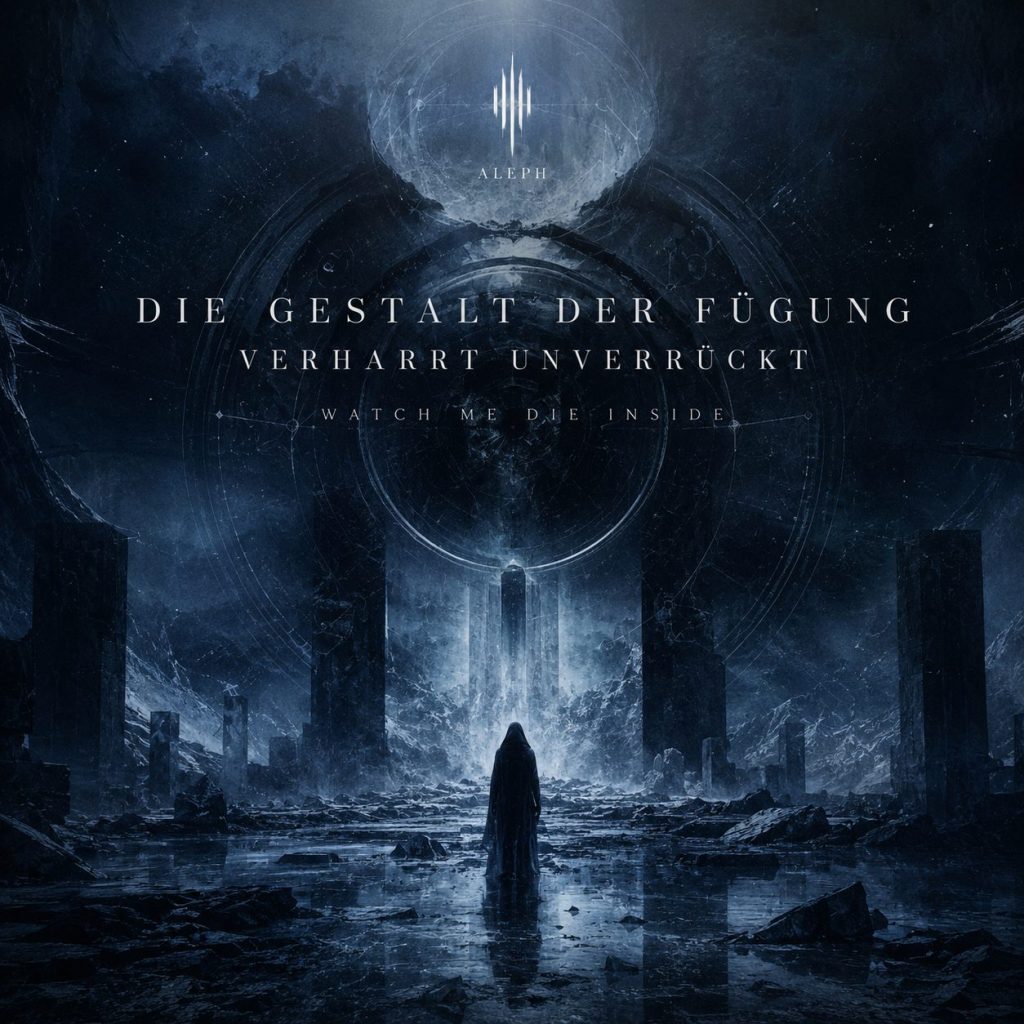
The German title, which translates roughly to the form of providence remaining immovable or the shape of fate standing unmoved, captures the precise philosophical territory the track inhabits. The Gestalt, the form or shape or configuration, of Fügung, which carries meanings of providence and fate and the way things are joined or arranged, remains verharrt unverrückt, persisting unmoved and unshifted regardless of anything that happens within it. This is determinism rendered as a fixed and immovable structure, the pattern that does not bend to individual will because individual will is itself part of the pattern, the design that contains even the attempts to escape it. The choice of German for the title adds a philosophical weight and a specific cultural resonance, German being the language of so much of the philosophical tradition that has grappled most rigorously with questions of freedom and determination and the nature of the will.
The sonic approach that Watch Me Die Inside brings to this philosophical content is built on cold atmospheres and overwhelming intensity and a persistent sense of existential unease, the music functioning not as a description of the dread but as its direct sonic embodiment. This is the appropriate approach for material this conceptually heavy, the cold atmospheres creating the emotional temperature of confronting a universe that may be indifferent to human freedom, the overwhelming intensity matching the magnitude of the question being asked, the persistent existential unease being the felt experience of looking closely at the possibility that free will is an illusion. The music does not argue the philosophical position so much as make the listener feel what it would be like to genuinely believe it, the dread transformed into a sonic experience that bypasses intellectual debate and arrives directly in the body and the nervous system.
The broader project that Watch Me Die Inside represents gives the individual track additional depth and significance. Every song is a Fragment, and every release contributes to an ever-expanding Autopsy of the modern human condition, the project chronicling the slow disintegration of identity in a world obsessed with performance and conformity and self-construction. This framing of the work as ongoing autopsy is genuinely striking, the autopsy being the examination of something already dead in order to determine the cause and the nature of its death, the suggestion being that the modern human condition is in some sense a corpse to be examined rather than a living thing to be celebrated. Each Fragment adds another section to this examination, the cumulative project building toward a comprehensive understanding of how identity disintegrates under the specific pressures of contemporary existence.
The disintegration of identity that Aleph chronicles connects directly to the determinism theme of this particular Fragment. A world obsessed with performance and conformity and self-construction is a world in which the self becomes a project to be managed and optimized and displayed rather than a genuine interior reality, and the question of free will becomes particularly acute in this context, because if the self is constructed according to external pressures and expectations, then in what sense is it free? The performance of identity that contemporary culture demands may itself be evidence of the determinism the track explores, the choices about how to present and construct the self being shaped by forces that the individual did not choose and cannot fully see, the pattern operating through the very acts of self-construction that seem to express freedom.
The track’s refusal to ask the listener to believe, asking instead only that they look closer, is the most philosophically sophisticated aspect of its presentation. This is not propaganda for determinism or an argument intended to convince but an invitation to examine the evidence of one’s own experience, to notice the pattern that was always there, to look closely at the texture of one’s own decisions and detours and rebellions and consider whether they were as free as they felt. The invitation to witness rather than to believe respects the listener’s autonomy even as the track questions whether that autonomy is real, the paradox being part of the point, the asking of the question being itself either a free act or a determined one depending on the very answer the track refuses to provide.
Watch Me Die Inside operates in the tradition of the most serious dark electronic and industrial music, the tradition that uses the genre’s capacity for cold atmosphere and overwhelming intensity to engage with genuinely difficult philosophical and existential content rather than simply for aesthetic effect. Die Gestalt der Fügung verharrt unverrückt is a Fragment of an ongoing autopsy, a piece of music that transforms one of philosophy’s most unsettling questions into a sonic experience, and its refusal to resolve the question or to comfort the listener is exactly what gives it its power.
The pattern was always there. Watch Me Die Inside asks you only to look closer and witness it, and the looking may change how you understand every choice you have ever made.