There is a specific kind of musician who never stopped after the band’s first formation, who went from the initial excitement of making something with another person straight into the sustained private practice of continuing to make things regardless of whether the circumstances were ideal, the lineup stable, the commercial prospects encouraging, or the world paying sufficient attention. Thomas Young, the creative force behind Victims of the New Math, has been this kind of musician for over twenty years, releasing home-grown indie and lo-fi rock across multiple albums and EPs with the consistency of someone who understood early that the writing was the point and everything else, the audience and the acclaim and the perfect conditions, was supplementary. The Stories That You Weave, released May 1, 2026, is the latest evidence that two decades of not stopping produces something that cannot be replicated by shorter and more strategically managed creative careers.
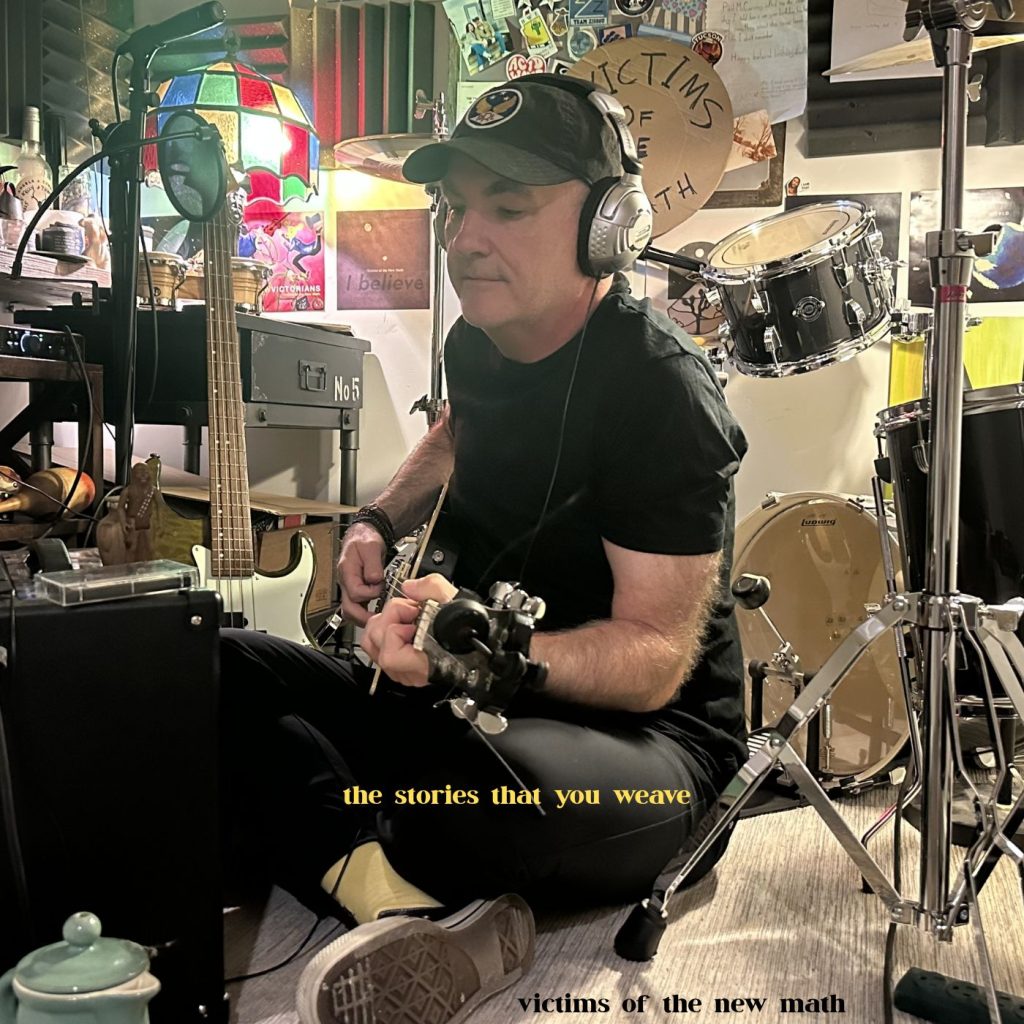
Victims of the New Math began as a duo, Thomas joined by his brother Joe, the band formed with the specific ambition of capturing the AM rock sounds from their childhood, the warm and melodic and slightly nostalgic quality of the radio rock that formed the sonic backdrop of a particular era’s growing up. The immediately interesting detail from Thomas’s account of the band’s beginning is that he never much wanted to learn other people’s songs. He wanted to write his own from the start, which is either an unusual confidence in a beginning musician or an unusual impatience with the idea that you have to earn the right to make original music through a period of imitation, and in Thomas’s case it turned out to be the productive kind of impatience, the kind that generates a catalog rather than simply a statement of intent.
The lo-fi production approach that has always characterized Victims of the New Math is not a limitation accepted because professional recording is unavailable but a deliberate aesthetic choice that connects the music to a tradition of independent recording that goes back through Guided by Voices and Sebadoh and the Mountain Goats and further, the understanding that the warmth and the character of home recording, the slight roughness of the edges and the specific quality of space that a non-professional room introduces into a recording, carries emotional information that the sanitized perfection of high-budget studio production frequently removes. Thomas Young writes, records, and produces everything himself, playing vocals and guitars and bass and keyboards and drums across the twelve tracks of The Stories That You Weave, the self-sufficiency being both practical and philosophical, the songs existing in exactly the form that one creative intelligence decided they should exist in.
The professional mastering by Todd Tobias brings the sonic character of the self-recorded material into the range where it can be heard on any playback system with full fidelity, the mastering not removing the lo-fi warmth but clarifying and preserving it, the full sound Tobias provides being the bridge between the intimate home recording context and the wider distribution context into which the album is released. This is the correct use of professional production input in a project like this one, the enhancement of what is already there rather than the transformation of it into something different.
The Run Up opens the album with the momentum that its title implies, the structural decision to begin with something driving and forward-moving establishing the sonic territory that the album will explore from multiple angles across its twelve tracks. You’re A Star arrives as one of the album’s most classically indie rock moments, the vintage-sounding riff-driven approach that the band description identifies as central to their identity present in full force, the song having the quality of something that has been in the back of the mind since childhood when certain guitar tones first lodged permanently in the pleasure centers of the brain. Only in My Dreams and Be What You Want inhabit the melodic center of the album, the AM rock inheritance from the band’s formation most audible in the melodic construction of both, the warmth and the accessibility serving the themes of love and loss and staying positive that the album addresses across its runtime.
Time Flies is described as a ballad-like travel journal, and the description is precise, the song having the quality of something written in transit, the observations accumulating in the way that they accumulate when you are moving through space and the ordinary anchor of daily life is suspended, the reflectiveness of the traveler’s perspective giving the lyrical content a quality of honest stock-taking that the busy-ness of stationary life frequently prevents. The fleetingness of fame that appears as one of the album’s thematic concerns is most likely present here, the road perspective providing the natural context for thinking about what persists and what dissipates as time moves through you.
We Can Be Anything and Believe In Me occupy the album’s more optimistic register, the dreamy indie-pop quality of Believe In Me that the press materials identify being one of the most immediately accessible moments on a record that contains considerable sonic variety. The dreaminess is genuine rather than produced, the quality of a melody that was heard internally before it was recorded rather than one that was constructed from available sonic components, and this distinction is one of the things that twenty years of consistent writing produces in a songwriter, the instinct for melody that arrives from the inside rather than being assembled from the outside.
It’s You That Wanted More brings the sixties garage rock dimension of the album into its fullest expression, the garage rock tradition being one of the more honest and more physically direct forms in rock history, the primitive recording conditions and the minimal technical sophistication of the original garage recordings producing a rawness that subsequent music has been trying to recreate with expensive equipment ever since. Young’s access to the genuine lo-fi approach rather than the simulated version gives the garage rock moments on the album an authenticity that the expensive recreation frequently cannot match. Every Day Is Saturday carries the quality of a life organized around the creative practice rather than the professional obligation, the day of the week whose texture belongs to the person living it rather than to the demands of employment, and for a musician who has been making home-recorded albums for twenty years the everyday Saturday is not a fantasy but a description of how the time actually gets used.
The Run Out mirrors the opening track with the structural symmetry that good sequencing produces, the bookending of the album’s journey with tracks whose titles indicate departure and arrival giving the sequence a shape that makes the full listening experience feel complete rather than simply concluded. Packing List and Return to the Universe close the record with the travel and cosmic imagery that the album has been building toward, the packing list being the preparation for a journey and the return to the universe being the journey’s ultimate destination, the dissolution of the individual back into the larger whole that the best rock music about cosmic themes has always been pointing toward.
The diverse and exciting sounds that fill The Stories That You Weave, the glam rock and new wave and psychedelic rock and indie rock and lo-fi rock that the band has incorporated across fifteen years of releases, all present in different proportions across the twelve tracks, are the accumulated evidence of what a curious and persistent musical intelligence produces when it never stops listening and never stops writing. Thomas Young has been doing this for over two decades and the stories he weaves keep getting richer.