There is a moment of recognition that arrives for many people who once believed that the great project of their time was the dismantling of old superstitions, the dawning awareness that the rational utopia they were promised has not materialized, that the secular world they helped build has developed its own orthodoxies and its own heresies and its own mechanisms for punishing those who refuse to conform. Motihari Brigade have built their entire third album around this recognition, and Save Ourselves, released June 1, 2026 ahead of the album Problematic, asks the uncomfortable question of where the independent thinkers are supposed to go when the society around them has taken on the very characteristics of the cults it claimed to have outgrown.
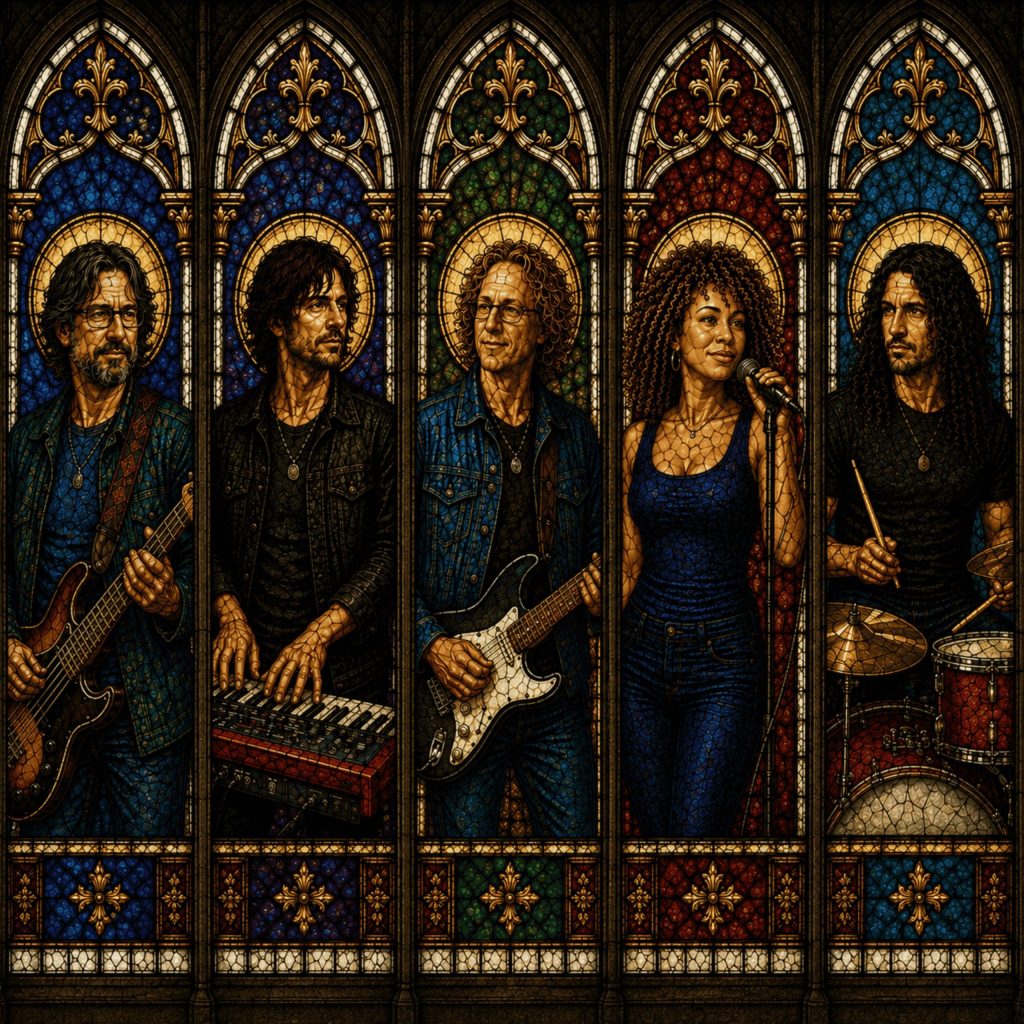
The band takes its name from Motihari, the town in India where George Orwell was born, and Orwell is the presiding spirit over the entire enterprise, the truth-seeking writer whose lifelong project was the defense of clear thought and honest language against the distortions of power and ideology. To name a band after Orwell’s birthplace is to declare allegiance to his particular form of intellectual courage, the willingness to see clearly even when clear sight is unwelcome, the refusal to accept the comfortable lies that every era’s powerful prefer their populations to believe. The forthcoming album Problematic arrives on June 25, 2026, Orwell’s birthday, a fitting tribute to the writer who gave the world the vocabulary of thoughtcrime and doublethink that Motihari Brigade now deploy against the orthodoxies of the present.
The intellectual provocation at the center of Save Ourselves is genuinely bracing. The song’s concept observes that many who followed the New Atheist thinkers like Dawkins and Hitchens and Harris assumed that discarding traditional religion would automatically produce a more rational and scientific and therefore better world, only to discover that human nature clings to dogmatic belief even in secular forms, especially when those beliefs reinforce a flattering narrative of one’s own moral superiority over disfavored others. This is an observation that cuts deep, the recognition that the impulse toward dogmatism and self-righteousness and the demonization of out-groups did not vanish with religious belief but simply migrated into new secular containers, the cultish intolerance that disillusioned so many about institutional religion reappearing in the supposedly enlightened secular consensus that replaced it.
The band extends this analysis into a critique of how official narratives and algorithmic controls now curate an artificial reality that promotes division and war, the manufactured culture of conflict ultimately serving the interests of the oligarch billionaires and political class who benefit from a divided and distracted population. This divide and rule perspective is one that does not map neatly onto conventional political alignments, the suggestion being that much of the heated division that consumes contemporary life is itself manufactured, a tool of control rather than a genuine expression of irreconcilable values. Whether one accepts this analysis fully or partially, engaging with it requires exactly the kind of independent thinking that the song champions, the willingness to question the narratives offered by all sides rather than accepting any of them uncritically.
The provocative question the song raises about whether deeply-rooted human spiritual traditions might still have value compared to the techno-dystopian machine that has taken over is the kind of genuinely heterodox thought that the contemporary consensus tends to discourage. Having followed the New Atheists toward the rejection of religious tradition, the song suggests, we might reconsider whether something valuable was discarded along with the superstition, whether the spiritual traditions that humans developed over millennia contained wisdom that the algorithmic machine cannot replicate. This is not a call to return to religious orthodoxy but an invitation to question the assumption that the secular technological present represents unambiguous progress, exactly the kind of question that an independent thinker should be free to ask.
Motihari Brigade’s proposed answer to the predicament they diagnose is rock and roll thoughtcrime, the phrase fusing Orwell’s concept of forbidden thought with the rebellious tradition of rock music. Rock and roll has always been a vehicle for refusing conformity and asserting individual freedom, and the band reclaims this tradition for the specific contemporary battle of maintaining independent thought against algorithmically curated reality. The vibrato electric guitar strings that the album promises to shake loose a world of illusions are the weapon in this battle, the rock energy directed at the project of seeing clearly through the manufactured consensus that surrounds us.
The album’s title, Problematic, reclaims a word that has become an instrument of conformist enforcement, the labeling of dissenting thought as problematic being one of the primary mechanisms by which the contemporary consensus polices its boundaries. By embracing the label, Motihari Brigade transform an instrument of control into a badge of honor, insisting that being problematic, being willing to question and dissent and think for oneself, is precisely what is needed when the surrounding society has become a cult demanding conformity.
The accompanying podcast featuring an imagined discussion between George Orwell and Socrates and Jesus Christ about the album reflects the project’s playful intellectual seriousness, these three figures all being truth-seekers who challenged the orthodoxies of their times and paid dearly for it. Their imagined consensus that Pink Floyd’s Dark Side of the Moon set the standard for the concept album places Problematic in the lineage of ambitious rock that uses the album form to explore serious ideas, and the band’s invention by guitarist and singer and songwriter Eric Winston reflects a singular creative vision pursuing genuine intellectual and artistic ambition.
Save Ourselves is the rallying cry of an album dedicated to restoring the defiant spirit of independent thought in an age that increasingly discourages it. Where do the questioners go when society becomes the cult? Motihari Brigade suggest they go to rock and roll, to the thoughtcrime that might still shake loose the world of illusions and allow us, perhaps, to save ourselves.
The questions remain worth asking. Motihari Brigade have made the music that insists on the right to keep asking them.