Heavy music has always maintained a special relationship with grand world-building, where complex narrative concepts match the sheer weight of downtuned guitars and thunderous percussion. Yet few modern metal projects manage to balance expansive sci-fi lore with intimate human emotion without drowning in their own technical ambition. Enter Wildcard Campfire, a faceless creative project led by guitarist and mastermind Rom Burla, which recently unveiled its sprawling ten-track debut album, Where God Grew Tired. Clocking in at fifty-five minutes, this ambitious record merges melodic metalcore, polyrhythmic djent, post-metal atmosphere, deathcore aggression, and cinematic orchestral scoring into a cohesive sonic tapestry. Rather than presenting a simple sequence of heavy songs, the album functions as a complex historical archive of a fictional civilization destroying itself, retreating underground, and eventually returning thousands of years later with a distorted memory of the world that came before.
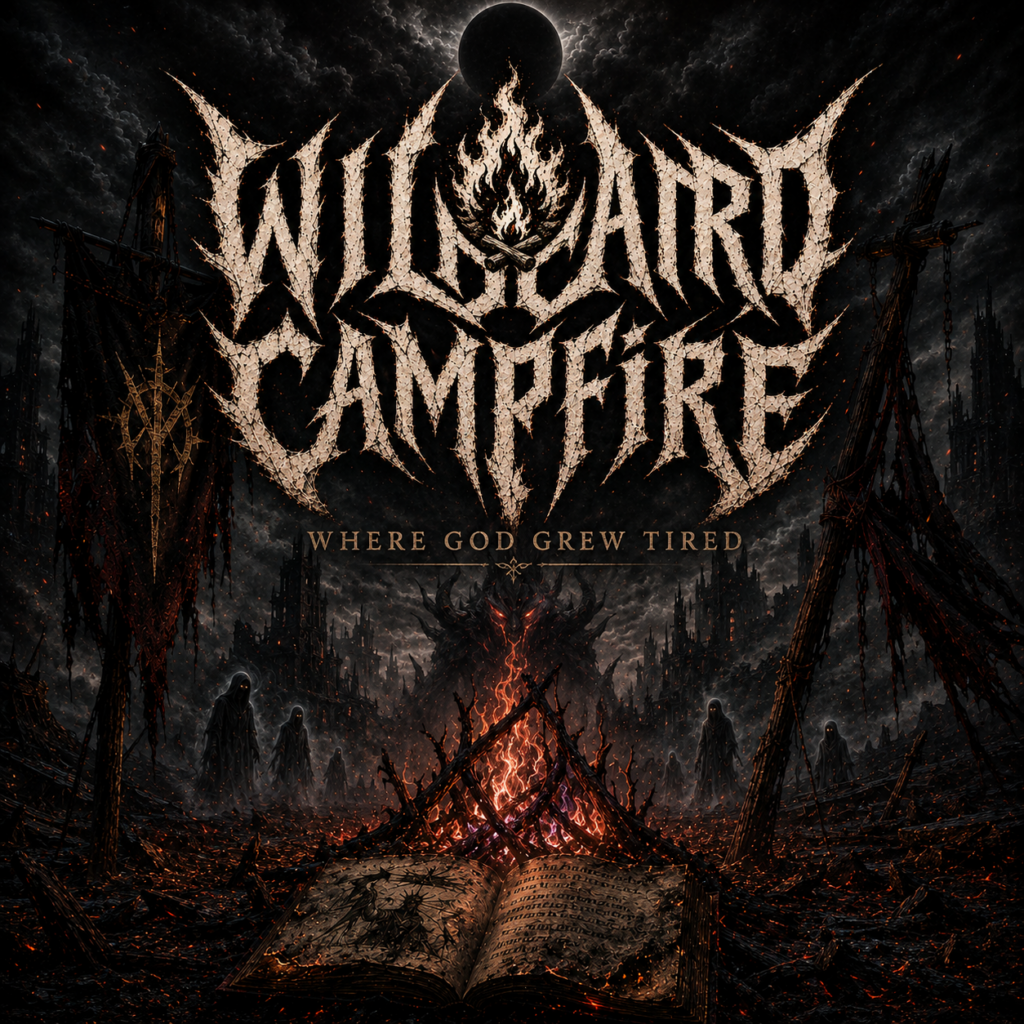
The album opens with The Beast With My Name, an immediate four-and-a-half-minute assault that sets the narrative and musical parameters for the entire journey. Low-tuned guitar riffs crunch with relentless djent precision, driven forward by punishing drum patterns that lock into intricate, syncopated grooves. Beneath the heavy distortion, subtle orchestral textures and ambient pads expand the stereo field, giving the track a widescreen, cinematic scale that feels tailored for a dark cinematic score. The vocal delivery moves fluidly between deep deathcore growls and rhythmic metalcore barks, capturing the internal psychological decay of a leader consumed by the very fear and hatred they created. It is an explosive introduction that establishes the record’s primary theme, demonstrating how systemic violence eventually turns inward on the person holding power.
At the literal and emotional center of the record lies The Ashen Gospel, a monumental three-part suite that traces the birth, peak, and apocalyptic aftermath of a global rebellion. The first movement, Before the Banners Burn, spans over seven minutes, patiently weaving delicate post-metal ambient passages together with heavy progressive metal weight to depict a society on the precipice of war. When the second movement, When the Banners Burn, arrives later in the tracklist, the tempo surges into relentless deathcore breakdowns and razor-sharp guitar leads that simulate the visceral chaos of conflict. Finally, the seven-minute title track, Where God Grew Tired, closes the entire album with a majestic, melancholy sweep, blending orchestral string arrangements with crushing, low-end riffs to mourn a world left in ruins. This central trilogy acts as a masterclass in structural pacing, showing how heavy music can convey historical scale through dynamic contrast.
Beyond its grand revolutionary arc, the album repeatedly zooms in on sharp personal details and unexpected tonal shifts that give the fictional universe a living, breathing pulse. A prime example is Khinkali Inferno, a tight three-and-a-half-minute track that discovers dark humor and genuine human warmth at a dinner table set between horrific battles. The guitar work here marries technical metalcore riffs with an upbeat, almost festive rhythmic bounce, reminding the listener that love, appetite, and endurance survive even within warzones. Similarly, The Legend of the Shanenigator introduces a deliberately absurd piece of domestic lore into the tracklist, utilizing chaotic tempo changes and frantic synth melodies to mimic household madness. These unexpected lighthearted moments prevent the album’s post-apocalyptic narrative from feeling monotonous, proving that true survival requires humor alongside strength.
Tracks like Paradise Has Walls and Shackles of Blood pivot back toward psychological tension, examining how institutional violence settles permanently inside individual minds. Paradise Has Walls builds its five-and-a-half-minute duration around a suffocating, atmospheric siege, using layered guitar harmonies and soaring clean vocal melodies to represent the claustrophobia of rigid religious control. Meanwhile, Shackles of Blood leans heavily into progressive metal structures, utilizing shifting time signatures and heavy basslines to follow the afterlife of trauma moving through a person’s veins. The Ghosts of My Past extends this private grief across nearly seven minutes of melancholic post-metal exploration, allowing clean guitar tones and spacious drum reverbs to carry the emotional weight before dissolving into a wall of cathartic feedback. Every song occupies a specific narrative vantage point, reinforcing the idea that war survives inside language, memories, and homes long after battlefields clear.
From a production standpoint, the record demonstrates an extraordinary commitment to clarity, depth, and dynamic power. Rom Burla developed all the guitar riffs, lyrics, melodies, and structural concepts on guitar, creating a unified creative direction that holds the fifty-five-minute runtime together. The production balance allows every sub-bass frequency in the djent breakdowns to hit with maximum chest-thumping impact while keeping the orchestral sweeps and delicate keyboard lines completely audible in the upper register. Rather than burying the instrumentation under a wall of brickwalled compression, the mix leaves generous dynamic room for quiet ambient passages to breathe before heavy riffs explode back into the foreground. This attention to sonic detail elevates the project, ensuring that the heavy passages sound truly massive while the atmospheric moments retain their fragile beauty.
Contextualizing Where God Grew Tired within the project’s broader release history reveals a creative team that spent months establishing its sonic identity through standalone singles. Earlier releases like A Hymn for the Unburied, Make It Pop, and The Lowest Point opened different doors into the same thematic universe, earning feature coverage and playlist support across international metal publications like HEAVY Magazine, RockCulture, and Roadie Metal. While those three standalone tracks sit outside this ten-song album sequence, they established the era’s signature blend of no-clean djent aggression, widescreen melodic metalcore, and post-hardcore weight. The full album takes those established musical elements and arranges them into a definitive, long-form narrative statement that completely justifies its length.
Naturally, listeners who prefer short, straightforward verse-chorus radio singles or traditional three-minute thrash tracks might find the album’s complex narrative structure and fifty-five-minute runtime demanding on first listen. The record requires patience, inviting the audience to track recurring thematic motifs and surrender to long instrumental passages that build with deliberate, slow-burning intensity. It makes no attempt to simplify its lore or soften its brutal deathcore edges for quick commercial appeal, choosing instead to construct a dense, immersive world. Yet evaluating the release strictly within the realm of progressive metalcore and conceptual art reveals an extraordinarily well-crafted debut that satisfies on every level. Criticizing its conceptual scope would be to ignore the immense ambition and craftsmanship holding every measure together.
Ultimately, Where God Grew Tired succeeds because it treats heavy music as a legitimate medium for grand, cinematic storytelling. By marrying virtuosic djent riffs and crushing deathcore breakdowns with rich orchestral scoring and deeply human lyricism, Wildcard Campfire has delivered one of the most impressive debut albums of the year. The record stands as a vibrant testament to the power of creative vision, proving that metal can be both brutally heavy and profoundly thoughtful at the exact same time. Listeners ready to step into a dark, beautifully detailed post-apocalyptic world will find this album to be an unforgettable, deeply rewarding musical journey.