
Constructing an authentic artistic identity out of systemic industrial decay demands a rare, stubborn resilience. The post-industrial sprawl of Northeast Ohio has long served as a quiet graveyard for abandoned factories and broken promises, yet it also remains a fertile incubator for aggressive, uncompromising self-expression. Akron solo creator Zmack captures this exact collision of environmental abandonment and internal survival on his monumental early August album release titled Rustbelt Rejects. Operating entirely on his own terms from home setups across the region, he converts years of personal grief, institutional survival, and regional pride into a volatile, multi-genre sonic weapon.
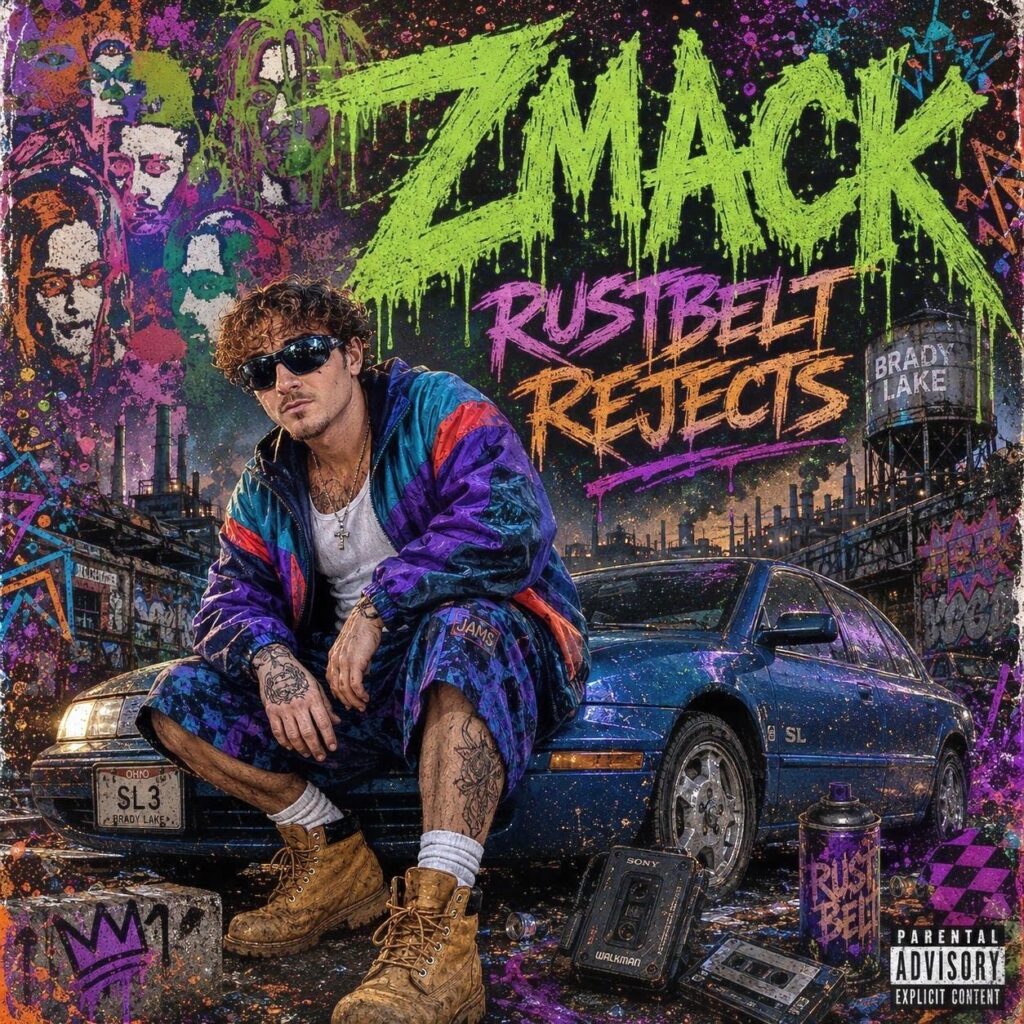
The foundational roots of this ambitious project trace back to middle school, built alongside his late best friend and primary musical partner CJ. The duo spent endless hours crafting beats, exchanging raw verses, and dissecting aggressive underground records, establishing an intuitive creative chemistry that defined Zmack’s artistic origin. Following CJ’s passing several years ago, the surviving artist transformed his devastating grief into an unyielding commitment to refine his craft. This project functions as an active, living monument to that foundational friendship, proving that a shared creative spirit can comfortably survive physical mortality.
Navigating life after serving time in prison required a complete dedication to quiet, obsessive self-improvement behind closed doors. Longtime friends who knew him prior to his incarceration have expressed genuine astonishment at the massive evolution in his technical execution and vocal confidence. He completely sidestepped standard commercial formulas, choosing instead to build an expansive auditory universe entirely by hand. Handlighting every aspect of beat production, vocal arrangement, and writing himself alongside mixing support from his collaborator Dave, Zmack quietly built an independent fortress completely untouched by corporate industry interference.
Executing such an unorthodox vision requires a radical disregard for traditional genre boundaries. The eight-track collection operates as a violent melting pot where underground Memphis trap, shadow rap, and horrorcore collide directly against doom metal, industrial, dubstep, phonk, and nineties funk-metal. Drawing vocal inspiration from modern underground icons while channeling the raw, unvarnished passion of classic funk-metal frontmen, he crafts a vocal approach that shifts fluidly between aggressive syllable-stacking and emotive, rhythmic singing. This massive stylistic hybrid prevents the project from ever feeling contrived or locked into a predictable formula.
Opening the album with the atmospheric weight of Rust Sound immediately establishes the physical and emotional geography of the region. Heavily distorted basslines and industrial power-tool textures pulse beneath a gritty, rhythmic vocal delivery, simulating the mechanical hum of an abandoned manufacturing plant. The track captures the exact spirit of growing up in an overlooked environment that retains an undeniable, stubborn character despite decades of economic neglect. It serves as an explosive introductory statement that proudly anchors the entire project in the heavy soil of Northeast Ohio.
Shifting toward personal heritage, Blood of the Irish explores his Irish-American identity through a surprisingly aggressive, cadence-heavy delivery. Broadening the narrative beyond simple geographical commentary, the track taps into a deep reservoir of historic pride, generational struggle, and unyielding personal determination. The production layers sweeping electronic textures over sharp percussive hits, creating a frantic momentum that mirrors an intense internal march. He delivers every line with a fierce, unvarnished conviction that forces the listener to acknowledge the deep ancestral roots driving his daily hustle.
Exploring the darker, stranger corners of his creative psyche leads directly into the grimy experimentation of Dirty Muskrat. Here, the artist completely abandons conventional hip-hop song structures in favor of an erratic arrangement heavily influenced by alternative rock and metal dynamics. He incorporates distorted slap-bass sounds, treating the instrument as a harsh, broken percussive element rather than a standard low-end anchor. The lyrics blend bleak, unsettling imagery with a distinct sense of Rustbelt humor, demonstrating a remarkable ability to extract dark comedy from uncomfortable situations. It stands out as one of the most uniquely unsettling moments on the entire record.
Building heavy low-end frequency responses demands an experimental approach to modern bass design and digital sound manipulation. Across tracks like Brady Lake Phonk and Shooter (Rusty Romp), the production mixes dubstep-inspired sub-bass pulses with classic Memphis-style drum programming. He resamples raw mechanical noises and distorts analog textures until they interact seamlessly with sharp electronic synths. This calculated DIY engineering creates a dense audio field that feels delightfully rough around the edges, entirely rejecting the sterile, over-quantized polish of modern radio rap.
The underlying emotional engine driving this album relies heavily on the profound contrast between heavy, abrasive noise and genuinely fun, infectious grooves. Tracks like Pressure, Streetlights, and Clown navigate themes of societal pressure, isolation, and personal accountability without ever descending into empty, performative despair. The rhythms consistently push forward with an energetic bounce that compels physical movement even as the lyrics explore difficult personal terrain. This delicate balance ensures the album remains deeply engaging and replayable across multiple listens.
Documenting this complex emotional journey required an uncompromising commitment to complete truthfulness across every written verse. He firmly refuses to manufacture a fake persona or chase temporary viral trends, delivering unfiltered snapshots of his lived reality instead. Listeners are invited into a raw, highly personal space shaped by loss, recovery, loyalty, and an unshakeable dedication to growth. This absolute sincerity elevates the record far beyond a simple collection of heavy songs, transforming it into an authentic document of human endurance.
Bringing these dense studio creations to life represents the crucial next phase of his evolving independent career. With raw, unvarnished performance videos and live regional appearances on the horizon, the artist is preparing to translate his heavily layered studio sound into a visceral, face-to-face experience. Audiences engaging with his live presentation can expect the same unrefined energy and relentless physical drive that fuels his recordings. The music is designed to exist as an ongoing, evolving movement that continuously expands beyond the confines of the digital master file.
Standing as a monument to independent determination, Rustbelt Rejects proves that remarkable art can be constructed out of discarded remnants and sheer willpower. As the final distorted notes of the closing track decay into ambient room noise, the lingering sub-bass continues to hum softly in the quiet air. The listener is left sitting in the sudden silence with a profound appreciation for an artist who took the broken pieces of his environment and forged them into something entirely his own. Zmack has successfully delivered a fierce, unforgettable body of work that honors his past while boldly claiming his future.


